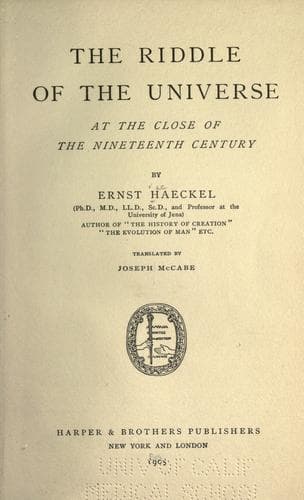
The Riddle of the Universe at the close of the nineteenth centuryHaeckel, Ernst
Religion
The Riddle of the Universe at the close of the nineteenth century
Haeckel, Ernst
Evolution; Monism; Religion and science; Soul
Pantheism teaches that God and the world are one. The idea of God is
identical with that of nature or substance. This pantheistic view is
sharply opposed in principle to all the systems we have described, and
to all possible forms of theism although there have been many attempts
made from both sides to bridge over the deep chasm that separates the
two. There is always this fundamental contradiction between them, that
in theism God is opposed to nature as an _extramundane_ being, as
creating and sustaining the world, and acting upon it from without,
while in pantheism God, as an _intramundane_ being, is everywhere
identical with nature itself, and is operative _within_ the world
as "force" or "energy." The latter view alone is compatible with
our supreme law--the law of substance. It follows necessarily that
pantheism is _the world-system of the modern scientist_. There are,
it is true, still a few men of science who contest this, and think it
possible to reconcile the old theistic theory of human nature with the
pantheistic truth of the law of substance. All these efforts rest on
confusion or sophistry--when they are honest.
As pantheism is a result of an advanced conception of nature in the
civilized mind, it is naturally much younger than theism, the crudest
forms of which are found in great variety in the uncivilized races of
ten thousand years ago. We do, indeed, find the germs of pantheism in
different religions at the very dawn of philosophy in the earliest
civilized peoples (in India, Egypt, China, and Japan), several thousand
years before the time of Christ; still, we do not meet a definite
philosophical expression of it until the hylozoism of the Ionic
philosophers, in the first half of the sixth century before Christ.
All the great thinkers of this flourishing period of Hellenic thought
are surpassed by the famous Anaximander, of Miletus, who conceived the
essential unity of the infinite universe (_apeiron_) more profoundly
and more clearly than his master, Thales, or his pupil, Anaximenes.
Not only the great thought of the original unity of the cosmos and the
development of all phenomena out of the all-pervading primitive matter
found expression in Anaximander, but he even enunciated the bold idea
of countless worlds in a periodic alternation of birth and death.
Public-domain text, read in full here on John Shaqi.
Reviews
Reviews
No reviews yet
Be the first to share your thoughts on this work.
Elsewhere in the archive
Join the Discussion
Join the discussion
Sign in to leave a comment or review.
Sign InorCreate an account