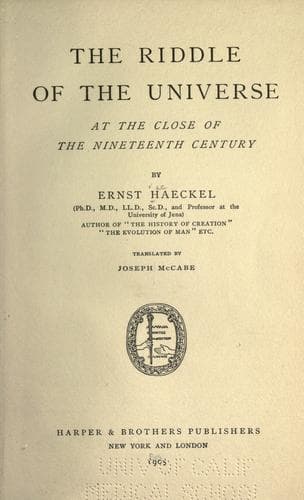
The Riddle of the Universe at the close of the nineteenth centuryHaeckel, Ernst
Religion
The Riddle of the Universe at the close of the nineteenth century
Haeckel, Ernst
Evolution; Monism; Religion and science; Soul
Many other great philosophers of classical antiquity, especially
Democritus, Heraclitus, and Empedocles, had, in the same or an
analogous sense, a profound conception of this unity of nature and
God, of body and spirit, which has obtained its highest expression
in the law of substance of our modern monism. The famous Roman poet
and philosopher, Lucretius Carus, has presented it in a highly poetic
form in his poem "De Rerum Natura." However, this true pantheistic
monism was soon entirely displaced by the mystic dualism of Plato, and
especially by the powerful influence which the idealistic philosophy
obtained by its blending with Christian dogmas. When the papacy
attained to its spiritual despotism over the world, pantheism was
hopelessly crushed; Giordano Bruno, its most gifted defender, was
burned alive by the "Vicar of Christ" in the Campo dei Fiori at Rome on
February 17, 1600.
It was not until the middle of the seventeenth century that pantheism
was exhibited in its purest form by the great Baruch Spinoza; he gave
for the totality of things a definition of substance in which God
and the world are inseparably united. The clearness, confidence, and
consistency of Spinoza's monistic system are the more remarkable when
we remember that this gifted thinker of two hundred and fifty years
ago was without the support of all those sound empirical bases which
have been obtained in the second half of the nineteenth century. We
have already spoken, in the first chapter, of Spinoza's relation to the
materialism of the eighteenth and the monism of the nineteenth century.
The propagation of his views, especially in Germany, is due, above
all, to the immortal works of our greatest poet and thinker, Wolfgang
Goethe. His splendid _God and the World_, _Prometheus_, _Faust_, etc.,
embody the great thoughts of pantheism in the most perfect poetic
creations.
Atheism affirms that there are no gods or goddesses, assuming that
god means a personal, extramundane entity. This "godless world-system"
substantially agrees with the monism or pantheism of the modern
scientist; it is only another expression for it, emphasizing its
negative aspect, the non-existence of any supernatural deity. In this
sense Schopenhauer justly remarks: "Pantheism is only a polite form
of atheism. The truth of pantheism lies in its destruction of the
dualist antithesis of God and the world, in its recognition that the
world exists in virtue of its own inherent forces. The maxim of the
pantheist, 'God and the world are one,' is merely a polite way of
giving the Lord God his _congé_."
Public-domain text, read in full here on John Shaqi.
Reviews
Reviews
No reviews yet
Be the first to share your thoughts on this work.
Elsewhere in the archive
Join the Discussion
Join the discussion
Sign in to leave a comment or review.
Sign InorCreate an account