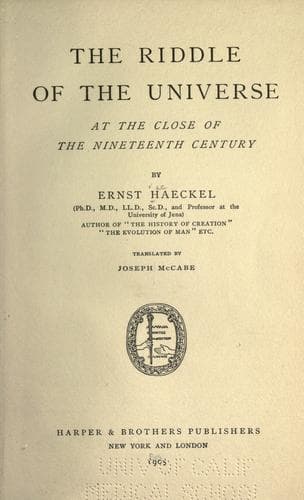
The Riddle of the Universe at the close of the nineteenth centuryHaeckel, Ernst
Religion
The Riddle of the Universe at the close of the nineteenth century
Haeckel, Ernst
Evolution; Monism; Religion and science; Soul
All knowledge of the truth depends on two different, but intimately
connected, groups of human physiological functions: firstly, on the
_sense-impressions_ of the object by means of sense-action, and,
secondly, on the combination of these impressions by an association
into _presentations_ in the subject. The instruments of sensation are
the sense-organs (_sensilla_ or _aestheta_); the instruments which
form and link together the presentations are the organs of thought
(_phroneta_). The latter are part of the central, and the former part
of the peripheral, nervous system--that important and elaborate system
of organs in the higher animals which alone effects their entire
psychic activity.
Man's sense-activity, which is the starting-point of all knowledge,
has been slowly and gradually developed from that of his nearest
mammal relatives, the primates. The sense-organs are of substantially
the same construction throughout this highest animal group, and their
function takes place always according to the same physical and chemical
laws. They have had the same historical development in all cases. In
the mammals, as in the case of all other animals, the _sensilla_ were
originally parts of the skin; the sensitive cells of the epidermis are
the sources of all the different sense-organs, which have acquired
their specific energy by adaptation to different stimuli (light, heat,
sound, chemical action, etc.). The rod-cells in the retina of the eye,
the auditory cells in the cochlea of the ear, the olfactory cells in
the nose, and the taste-cells on the tongue, are all originally derived
from the simple, indifferent cells of the epidermis, which cover the
entire surface of the body. This significant fact can be directly
proved by observation of the embryonic development of man or any of the
higher animals. And from this ontogenetic fact we confidently infer,
in virtue of the great biogenetic law, the important phylogenetic
proposition, that in the long historical evolution of our ancestors,
likewise, the higher sense-organs with their specific energies were
originally derived from the epidermis of lower animals, from a simple
layer of cells which had no trace of such differentiated sensilla.
Public-domain text, read in full here on John Shaqi.
Reviews
Reviews
No reviews yet
Be the first to share your thoughts on this work.
Elsewhere in the archive
Join the Discussion
Join the discussion
Sign in to leave a comment or review.
Sign InorCreate an account