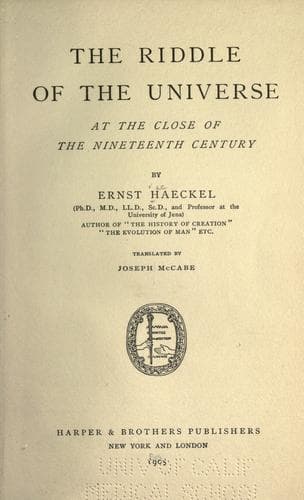
The Riddle of the Universe at the close of the nineteenth centuryHaeckel, Ernst
Religion
The Riddle of the Universe at the close of the nineteenth century
Haeckel, Ernst
Evolution; Monism; Religion and science; Soul
During the whole of the Middle Ages, under the bloody despotism of the
popes, atheism was persecuted with fire and sword as a most pernicious
system. As the "godless" man is plainly identified with the "wicked"
in the Gospel, and is threatened--simply on account of his "want of
faith"--with the eternal fires of hell, it was very natural that every
good Christian should be anxious to avoid the suspicion of atheism.
Unfortunately, the idea still prevails very widely. The atheistic
scientist who devotes his strength and his life to the search for
the truth, is freely credited with all that is evil; the theistic
church-goer, who thoughtlessly follows the empty ceremonies of Catholic
worship, is at once assumed to be a good citizen, even if there be no
meaning whatever in his faith and his morality be deplorable. This
error will only be destroyed when, in the twentieth century, the
prevalent superstition gives place to rational knowledge and to a
monistic conception of the unity of God and the world.
CHAPTER XVI
KNOWLEDGE AND BELIEF
The Knowledge of the Truth and Its Sources: the Activity of the
Senses and the Association of Presentations--Organs of Sense and
Organs of Thought--Sense-Organs and their Specific Energy--Their
Evolution--The Philosophy of Sensibility--Inestimable Value of the
Senses--Limits of Sensitive Knowledge--Hypothesis and Faith--Theory
and Faith--Essential Difference of Scientific (Natural) and
Religious (Supernatural) Faith--Superstition of Savage and of
Civilized Races--Confessions of Faith--Unsectarian Schools--The
Faith of Our Fathers--Spiritism--Revelation
Every effort of genuine science makes for a knowledge of the truth. Our
only real and valuable knowledge is a knowledge of nature itself, and
consists of presentations which correspond to external things. We are
incompetent, it is true, to penetrate into the innermost nature of this
real world--the "thing in itself"--but impartial critical observation
and comparison inform us that, in the normal action of the brain and
the organs of sense, the impressions received by them from the outer
world are the same in all rational men, and that in the normal function
of the organs of thought certain presentations are formed which are
everywhere the same. These presentations we call _true_, and we are
convinced that their content corresponds to the knowable aspect of
things. We _know_ that these facts are not imaginary, but real.
Public-domain text, read in full here on John Shaqi.
Reviews
Reviews
No reviews yet
Be the first to share your thoughts on this work.
Elsewhere in the archive
Join the Discussion
Join the discussion
Sign in to leave a comment or review.
Sign InorCreate an account