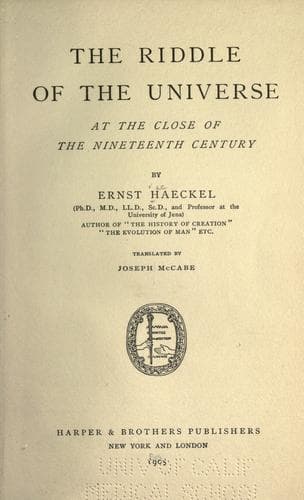
The Riddle of the Universe at the close of the nineteenth centuryHaeckel, Ernst
Religion
The Riddle of the Universe at the close of the nineteenth century
Haeckel, Ernst
Evolution; Monism; Religion and science; Soul
I thoroughly agree with his convincing work.
Critical comparison of sense-action in man and the other vertebrates
has brought to light a number of extremely important facts, the
knowledge of which we owe to the penetrating research of the
nineteenth century, especially of the second half of the century. This
is particularly true of the two most elaborate "æsthetic" organs,
the eye and the ear. They present a different and more complicated
structure in the vertebrates than in the other animals, and have also
a characteristic development in the embryo. This typical ontogenesis
and structure of the sensilla of all the vertebrates is only explained
by _heredity_ from a common ancestor. Within the vertebrate group,
however, we find a great variety of structure in points of detail, and
this is due to _adaptation_ to their manner of life on the part of the
various species, to the increasing or diminishing use of various parts.
In respect of the structure of his sense-organs man is by no means
the most perfect and most highly-developed vertebrate. The eye of the
eagle is much keener, and can distinguish small objects at a distance
much more clearly than the human eye. The hearing of many mammals,
especially of the carnivora, ungulata, and rodentia of the desert, is
much more sensitive than that of man, and perceives slight noises at a
much greater distance; that may be seen at a glance by their large and
very sensitive cochlea. Singing birds have attained a higher grade of
development, even in respect of musical endowment, than the majority of
men. The sense of smell is much more developed in most of the mammals,
especially in the carnivora and the ungulata, than in man; if the dog
could compare his own fine scent with that of man, he would look down
on us with compassion. Even with regard to the lower senses--taste,
sex-sense, touch, and temperature--man has by no means reached the
highest stage in every respect.
We can naturally only pass judgment on the sensations which we
ourselves experience. However, anatomy informs us of the presence in
the bodies of many animals of other senses than those we are familiar
with. Thus fishes and other lower aquatic vertebrates have peculiar
sensilla in the skin which are in connection with special sense-nerves.
On the right and left sides of the fish's body there is a long canal,
branching into a number of smaller canals at the head. In this "mucous
canal" there are nerves with numerous branches, the terminations of
which are connected with peculiar nerve-aggregates. This extensive
epidermic sense-organ probably serves for the perception of changes in
the pressure, or in other properties, of the water. Some groups are
distinguished by the possession of other peculiar sensilla, the meaning
of which is still unknown to us.
Public-domain text, read in full here on John Shaqi.
Reviews
Reviews
No reviews yet
Be the first to share your thoughts on this work.
Elsewhere in the archive
Join the Discussion
Join the discussion
Sign in to leave a comment or review.
Sign InorCreate an account