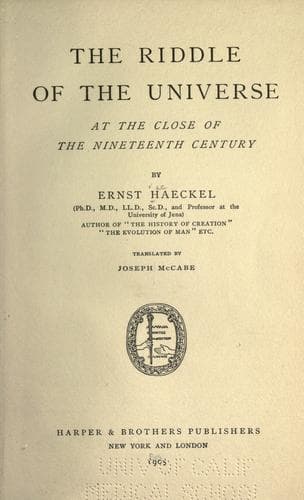
The Riddle of the Universe at the close of the nineteenth centuryHaeckel, Ernst
Religion
The Riddle of the Universe at the close of the nineteenth century
Haeckel, Ernst
Evolution; Monism; Religion and science; Soul
But it is already clear from the above facts that our human
sense-activity is limited, not only in quantity, but in quality also.
We can thus only perceive with our senses, especially with the eye
and the sense of touch, a part of the qualities of the objects in our
environment. And even this partial perception is incomplete, in the
sense that our organs are imperfect, and our sensory nerves, acting
as interpreters, communicate to the brain only a translation of the
impressions received.
However, this acknowledged imperfection of our senses should not
prevent us from recognizing their instruments, and especially the eye,
to be organs of the highest type; together with the thought-organs in
the brain, they are nature's most valuable gift to man. Very truly does
Albrecht Rau say: "All science is sensitive knowledge in the ultimate
analysis; it does not deny, but interpret, the data of the senses.
The senses are our first and best friends. Long before the mind is
developed the senses tell man what he must do and avoid. He who makes
a general disavowal of the senses in order to meet their dangers acts
as thoughtlessly and as foolishly as the man who plucks out his eyes
because they once fell on shameful things, or the man who cuts off
his hand lest at any time it should reach out to the goods of his
neighbor." Hence Feuerbach is quite right in calling all philosophies,
religions, and systems which oppose the principle of sense-action not
only erroneous, but really pernicious. Without the senses there is
no knowledge--"_Nihil est in intellectu, quod non fuerit in sensu_,"
as Locke said. Twenty years ago I pointed out, in my chapter "On the
Origin and Development of the Sense-Organs,"[32] the great service of
Darwinism in giving us a profounder knowledge and a juster appreciation
of the senses.
The thirst for knowledge of the educated mind is not contented with
the defective acquaintance with the outer world which is obtained
through our imperfect sense-organs. He endeavors to build up the
sense-impressions which they have brought him into valuable knowledge.
He transforms them into specific sense-perceptions in the sense-centres
of the cortex of the brain, and combines them into presentations,
by association, in the thought-centres. Finally, by a further
concatenation of the groups of presentations he attains to connected
knowledge. But this knowledge remains defective and unsatisfactory
until the imagination supplements the inadequate power of combination
of the intelligence, and, by the association of stored-up images,
unites the isolated elements into a connected whole. Thus are produced
new general presentative images, and these suffice to interpret the
facts perceived and satisfy "reason's feeling of causality."
Public-domain text, read in full here on John Shaqi.
Reviews
Reviews
No reviews yet
Be the first to share your thoughts on this work.
Elsewhere in the archive
Join the Discussion
Join the discussion
Sign in to leave a comment or review.
Sign InorCreate an account