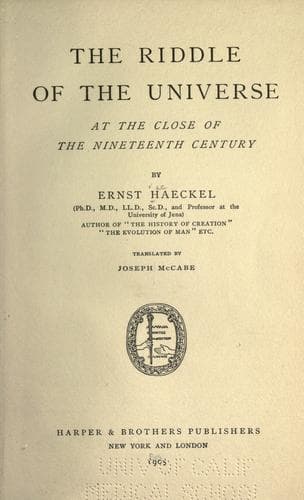
The Riddle of the Universe at the close of the nineteenth centuryHaeckel, Ernst
Religion
The Riddle of the Universe at the close of the nineteenth century
Haeckel, Ernst
Evolution; Monism; Religion and science; Soul
And if, from this impartial stand-point, we take a critical glance at
the kinds of faith that prevail to-day in civilized countries, we find
them everywhere saturated with traditional superstition. The Christian
belief in Creation, the Trinity, the Immaculate Conception, the
Redemption, the Resurrection and Ascension of Christ, and so forth, is
just as purely imaginative as the belief in the various dogmas of the
Mohammedan, Mosaic, Buddhistic, and Brahmanic religions, and is just
as incapable of reconciliation with a rational knowledge of nature.
Each of these religions is for the sincere believer an indisputable
truth, and each regards the other as heresy and damnable error. The
more confidently a particular sect considers itself "the only ark
of salvation," and the more ardently this conviction is cherished,
the more zealously does it contend against all other sects and give
rise to the fearful religious wars that form the saddest pages in the
book of history. And all the time the unprejudiced "critique of pure
reason" teaches us that all these different forms of faith are equally
false and irrational, mere creatures of poetic fancy and uncritical
tradition. Rational science must reject them all alike as the outcome
of superstition.
The incalculable injury which irrational superstition has done
to credulous humanity is conspicuously revealed in the ceaseless
conflict of confessions of faith. Of all the wars which nations have
waged against each other with fire and sword the religious wars have
been the bloodiest; of all the forms of discord that have shattered
the happiness of families and of individuals those that arise from
religious differences are still the most painful. Think of the millions
who have lost their lives in Christian persecutions, in the religious
conflicts of Islam and of the Reformation, by the Inquisition, and
under the charge of witchcraft. Or think of the still greater number
of luckless men who, through religious differences, have been plunged
into family troubles, have lost the esteem of their fellow-citizens
and their position in the community, or have even been compelled to
fly from their country. The official confession of faith becomes most
pernicious of all when it is associated with the political aims of
a modern state, and is enforced as "religious instruction" in our
schools. The child's mind is thus early diverted from the pursuit of
the truth and impregnated with superstition. Every friend of humanity
should do all in his power to promote unsectarian schools as one of the
most valuable institutions of the modern state.
Public-domain text, read in full here on John Shaqi.
Reviews
Reviews
No reviews yet
Be the first to share your thoughts on this work.
Elsewhere in the archive
Join the Discussion
Join the discussion
Sign in to leave a comment or review.
Sign InorCreate an account