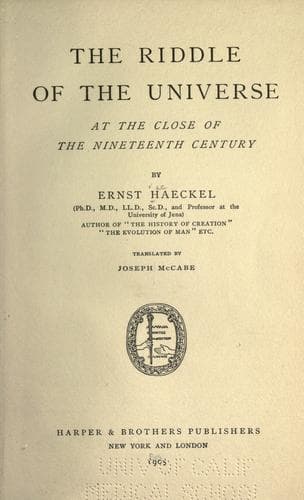
The Riddle of the Universe at the close of the nineteenth centuryHaeckel, Ernst
Religion
The Riddle of the Universe at the close of the nineteenth century
Haeckel, Ernst
Evolution; Monism; Religion and science; Soul
Owing to the great progress of ethnology during the century, we
have learned a vast quantity of different kinds and practices of
superstition, as they still survive in uncivilized races. When they are
compared with each other and with the mythological notion of earlier
ages, a manifold analogy is discovered, frequently a common origin, and
eventually one simple source for them all. This is found in the "demand
of causality in reason," in the search for an explanation of obscure
phenomena by the discovery of a cause. That applies particularly to
such phenomena as threaten us with danger and excite fear, like thunder
and lightning, earthquakes, eclipses, etc. The demand for a causal
explanation of such phenomena is found in uncivilized races of the
lowest grade, transmitted from their primate ancestors by heredity. It
is even found in many other vertebrates. When a dog barks at the full
moon, or at a ringing bell, of which it sees the hammer moving, or at a
flag that flutters in the breeze, it expresses not only fear, but also
the mysterious impulse to learn the cause of the obscure phenomenon.
The crude beginnings of religion among primitive races spring partly
from this hereditary superstition of their primate ancestors, and
partly from the worship of ancestors, from various emotional impulses,
and from habits which have become traditional.
The religious notions of modern civilized peoples, which they esteem
so highly, profess to be on a much higher level than the "crude
superstition" of the savage; we are told of the great advance which
civilization has made in sweeping it aside. That is a great mistake.
Impartial comparison and analysis show that they only differ in
their special "form of faith" and the outer shell of their creed.
In the clear light of reason the refined faith of the most liberal
ecclesiastical religion--inasmuch as it contradicts the known and
inviolable laws of nature--is no less irrational a superstition than
the crude spirit-faith of primitive fetichism on which it looks down
with proud disdain.
Public-domain text, read in full here on John Shaqi.
Reviews
Reviews
No reviews yet
Be the first to share your thoughts on this work.
Elsewhere in the archive
Join the Discussion
Join the discussion
Sign in to leave a comment or review.
Sign InorCreate an account