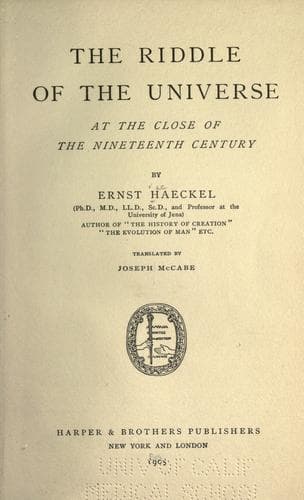
The Riddle of the Universe at the close of the nineteenth centuryHaeckel, Ernst
Religion
The Riddle of the Universe at the close of the nineteenth century
Haeckel, Ernst
Evolution; Monism; Religion and science; Soul
One of the most remarkable forms of superstition, which still takes a
very active part in modern life, is _spiritism_. It is a surprising
and a lamentable fact that millions of educated people are still
dominated by this dreary superstition; even distinguished scientists
are entangled in it. A number of spiritualist journals spread the
faith far and wide, and our "superior circles" do not scruple to hold
_séances_ in which "spirits" appear, rapping, writing, giving messages
from "the beyond," and so on. It is a frequent boast of spiritists that
even eminent men of science defend their superstition. In Germany, A.
Zöllner and Fechner are quoted as instances; in England, Wallace and
Crookes. The regrettable circumstance that physicists and biologists
of such distinction have been led astray by spiritism is accounted
for, partly by their excess of imagination and defect of critical
faculty, and partly by the powerful influence of dogmas which a
religious education imprinted on the brain in early youth. Moreover,
it was precisely through the famous _séances_ at Leipzig, in which the
physicists, Zöllner, Fechner, and Wilhelm Weber, were imposed on by
the clever American conjuror, Slade, that the fraud of the latter was
afterwards fully exposed; he was discovered to be a common impostor.
In other cases, too, where the alleged marvels of spiritism have been
thoroughly investigated, they have been traced to a more or less clever
deception; the mediums (generally of the weaker sex) have been found to
be either smart swindlers or nervous persons of abnormal irritability.
Their supposed gift of "telepathy" (or "action at a distance of thought
without material medium") has no more existence than the "voices" or
the "groans" of spirits, etc. The vivid pictures which Carl du Prel, of
Munich, and other spiritists give of their phenomena must be regarded
as the outcome of a lively imagination, together with a lack of
critical power and of knowledge of physiology.
Public-domain text, read in full here on John Shaqi.
Reviews
Reviews
No reviews yet
Be the first to share your thoughts on this work.
Elsewhere in the archive
Join the Discussion
Join the discussion
Sign in to leave a comment or review.
Sign InorCreate an account