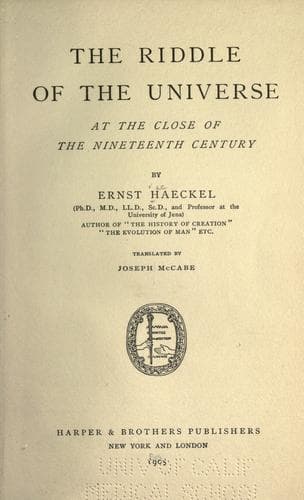
The Riddle of the Universe at the close of the nineteenth centuryHaeckel, Ernst
Religion
The Riddle of the Universe at the close of the nineteenth century
Haeckel, Ernst
Evolution; Monism; Religion and science; Soul
The majority of religions have, in spite of their great differences,
one common feature, which is, at the same time, one of their strongest
supports in many quarters. They declare that they can elucidate the
problem of existence, the solution of which is beyond the natural power
of reason, by the supernatural way of revelation; from that they derive
the authority of the dogmas which in the guise of "divine laws" control
morality and the practical conduct of life. "Divine" inspirations of
that kind form the basis of many myths and legends, the human origin of
which is perfectly clear. It is true that the God who reveals himself
does not always appear in human shape, but in thunder and lightning,
storm and earthquake, fiery bush or menacing cloud. But the revelation
which he is supposed to bring to the credulous children of men is
always anthropomorphic; it invariably takes the form of a communication
of ideas or commands which are formulated and expressed precisely as is
done in the normal action of the human brain and larynx. In the Indian
and Egyptian religions, in the mythologies of Greece and Rome, in the
Old and the New Testaments, the gods think, talk, and act just as men
do; the revelations, in which they are supposed to unveil for us the
secrets of existence and the solution of the great world-enigma, are
creations of the human imagination. The "truth" which the credulous
discover in them is a human invention; the "childlike faith" in these
irrational revelations is mere superstition.
The true revelation--that is, the true source of rational knowledge--is
to be sought in nature alone. The rich heritage of truth which forms
the most valuable part of human culture is derived exclusively from
the experiences acquired in a searching study of nature, and from the
rational conclusions which it has reached by the just association of
these empirical presentations. Every intelligent man with normal brain
and senses finds this true revelation in nature on impartial study, and
thus frees himself from the superstition with which the "revelations"
of religion had burdened him.
CHAPTER XVII
SCIENCE AND CHRISTIANITY
Public-domain text, read in full here on John Shaqi.
Reviews
Reviews
No reviews yet
Be the first to share your thoughts on this work.
Elsewhere in the archive
Join the Discussion
Join the discussion
Sign in to leave a comment or review.
Sign InorCreate an account