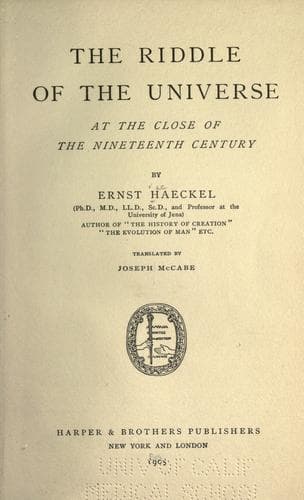
The Riddle of the Universe at the close of the nineteenth centuryHaeckel, Ernst
Religion
The Riddle of the Universe at the close of the nineteenth century
Haeckel, Ernst
Evolution; Monism; Religion and science; Soul
Let us first emphatically protest that it is a question for us of the
necessary defence of science and reason against the vigorous attacks
of the Christian Church and its vast army, not of an unprovoked
attack of science on religion. And, in the first place, our defence
must be prepared against Romanism or Ultramontanism. This "one ark
of salvation," this Catholic Church "destined for all," is not only
much larger and more powerful than the other Christian sects, but it
has the exceptional advantage of a vast, centralized organization
and an unrivalled political ability. Men of science are often heard
to say that the Catholic superstition is no more astute than the
other forms of supernatural faith, and that all these insidious
institutions are equally inimical to reason and science. As a matter
of general theoretical principle the statement may pass, but it is
certainly wrong when we look to its practical side. The deliberate and
indiscriminate attacks of the ultramontane Church on science, supported
by the apathy and ignorance of the masses, are, on account of its
powerful organization, much more severe and dangerous than those of
other religions.
In order to appreciate correctly the extreme importance of Christianity
in regard to the entire history of civilization, and particularly
its fundamental opposition to reason and science, we must briefly
run over the principal stages of its historical evolution. It may be
divided into four periods: (1) primitive Christianity (the first three
centuries), (2) papal Christianity (twelve centuries, from the fourth
to the fifteenth), (3) the Reformation (three centuries, from the
sixteenth to the eighteenth), and (4) modern pseudo-Christianity.
I.--PRIMITIVE CHRISTIANITY
Primitive Christianity embraces the first three centuries. Christ
himself, the noble prophet and enthusiast, so full of the love of
humanity, was far below the level of classical culture; he knew nothing
beyond the Jewish traditions; he has not left a single line of writing.
He had, indeed, no suspicion of the advanced stage to which Greek
philosophy and science had progressed five hundred years before.
Public-domain text, read in full here on John Shaqi.
Reviews
Reviews
No reviews yet
Be the first to share your thoughts on this work.
Elsewhere in the archive
Join the Discussion
Join the discussion
Sign in to leave a comment or review.
Sign InorCreate an account