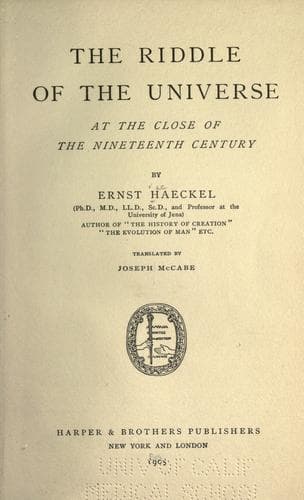
The Riddle of the Universe at the close of the nineteenth centuryHaeckel, Ernst
Religion
The Riddle of the Universe at the close of the nineteenth century
Haeckel, Ernst
Evolution; Monism; Religion and science; Soul
All that we know of him and of his original teaching is taken from the
chief documents of the New Testament--the four gospels and the Pauline
epistles. As to the four canonical gospels, we now know that they were
selected from a host of contradictory and forged manuscripts of the
first three centuries by the three hundred and eighteen bishops who
assembled at the Council of Nicæa in 327. The entire list of gospels
numbered forty; the canonical list contains four. As the contending
and mutually abusive bishops could not agree about the choice, they
determined to leave the selection to a miracle. They put all the books
(according to the _Synodicon_ of Pappus) together underneath the
altar, and prayed that the apocryphal books, of human origin, might
remain there, and the genuine, inspired books might be miraculously
placed on the table of the Lord. And that, says tradition, really
occurred! The three synoptic gospels (Matthew, Mark, and Luke--all
written _after_ them, not _by_ them, at the beginning of the second
century) and the very different fourth gospel (ostensibly "after"
John, written about the middle of the second century) leaped on the
table, and were thenceforth recognized as the inspired (with their
thousand mutual contradictions) foundations of Christian doctrine. If
any modern "unbeliever" finds this story of the "leap of the sacred
books" incredible, we must remind him that it is just as credible as
the table-turning and spirit-rapping that are believed to take place
to-day by millions of educated people; and that hundreds of millions of
Christians believe just as implicitly in their personal immortality,
their "resurrection from the dead," and the Trinity of God--dogmas that
contradict pure reason no more and no less than that miraculous bound
of the gospel manuscripts.
The most important sources after the gospels are the fourteen separate
(and generally forged) epistles of Paul. The genuine Pauline epistles
(_three_ in number, according to recent criticism--to the Romans,
Galatians, and Corinthians) were written before the canonical gospels,
and contain less incredible miraculous matter than they. They are
also more concerned than the gospels to adjust themselves with a
rational view of the world. Hence the advanced theology of modern times
constructs its "ideal Christianity" rather on the base of the Pauline
epistles than on the gospels, so that it has been called "Paulinism."
Public-domain text, read in full here on John Shaqi.
Reviews
Reviews
No reviews yet
Be the first to share your thoughts on this work.
Elsewhere in the archive
Join the Discussion
Join the discussion
Sign in to leave a comment or review.
Sign InorCreate an account