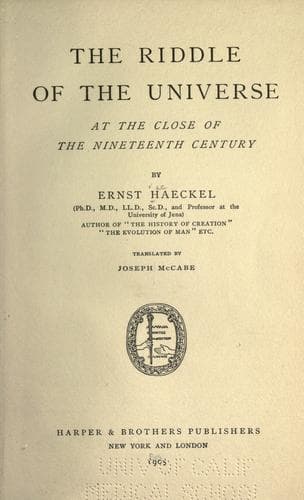
The Riddle of the Universe at the close of the nineteenth centuryHaeckel, Ernst
Religion
The Riddle of the Universe at the close of the nineteenth century
Haeckel, Ernst
Evolution; Monism; Religion and science; Soul
As the fourth and last stage in the history of Christianity we oppose
our nineteenth century to all its predecessors. It is true that the
enlightenment of preceding centuries had promoted critical thought in
every direction, and the rise of science itself had furnished powerful
empirical weapons; yet it seems to us that our progress along both
lines has been quite phenomenal during the nineteenth century. It
has inaugurated an entirely new period in the history of the human
mind, characterized by the development of the monistic philosophy
of nature. At its very commencement the foundations were laid of a
new anthropology (by the comparative anatomy of Cuvier) and of a new
biology (by the _Philosophie Zoologique_ of Lamarck). The two great
French scientists were quickly succeeded by two contemporary German
scholars--Baer, the founder of the science of evolution, and Johannes
Müller, the founder of comparative morphology and physiology. A
pupil of Müller, Theodor Schwann, created the far-reaching cellular
theory in 1838, in conjunction with M. Schleiden. Lyell had already
traced the evolution of the earth to natural causes, and thus proved
the application to our planet of the mechanical cosmogony which Kant
had sketched with so much insight in 1755. Finally, Robert Mayer and
Helmholtz established the principle of energy in 1842--the second,
complementary half of the great law of substance, the first half of
which (the persistence of matter) had been previously discovered by
Lavoisier. Forty years ago Charles Darwin crowned all these profound
revelations of the intimate nature of the universe by his new theory
of evolution, the greatest natural-philosophical achievement of our
century.
Public-domain text, read in full here on John Shaqi.
Reviews
Reviews
No reviews yet
Be the first to share your thoughts on this work.
Elsewhere in the archive
Join the Discussion
Join the discussion
Sign in to leave a comment or review.
Sign InorCreate an account