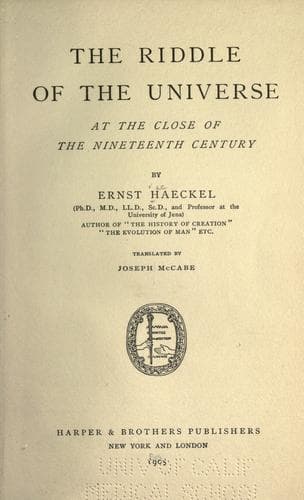
The Riddle of the Universe at the close of the nineteenth centuryHaeckel, Ernst
Religion
The Riddle of the Universe at the close of the nineteenth century
Haeckel, Ernst
Evolution; Monism; Religion and science; Soul
Yet the 31st of October in the year 1517, the day on which Martin
Luther nailed his ninety-five theses to the wooden door of Wittenburg
Cathedral, must be regarded as the commencement of a new epoch; for
on that day was forced the iron door of the prison in which the Papal
Church had detained fettered reason for twelve hundred years. The
merits of the great reformer have been partly exaggerated, partly
underestimated. It has been justly pointed out that Luther, like all
the other reformers, remained in manifold subjection to the deepest
superstition. Thus he was throughout life a supporter of the rigid
dogma of the verbal inspiration of the Bible; he zealously maintained
the doctrines of the resurrection, original sin, predestination,
justification by faith, etc. He rejected as folly the great discovery
of Copernicus, because in the Bible "Joshua bade the sun, not the
earth, stand still." He utterly failed to appreciate the great
political revolutions of his time, especially the profound and just
agitation of the peasantry. Worse still was the fanatical Calvin, of
Geneva, who had the talented Spanish physician, Serveto, burned alive
in 1553, because he rejected the absurd dogma of the Trinity. The
fanatical "true believers" of the reformed Church followed only too
frequently in the blood-stained footsteps of their papal enemies; as
they do even in our own day. Deeds of unparalleled cruelty followed
in the train of the Reformation--the massacre of St. Bartholomew and
the persecution of the Huguenots in France, bloody heretic-hunts in
Italy, civil war in England, and the Thirty Years War in Germany. Yet,
in spite of those grave blemishes, to the sixteenth and seventeenth
centuries belongs the honor of once more opening a free path to the
thoughtful mind, and delivering reason from the oppressive yoke of the
papacy. Thus only was made possible that great development of different
tendencies in critical philosophy and of new paths in science which
won for the subsequent eighteenth century the honorable title of "the
century of enlightenment."
IV.--THE PSEUDO-CHRISTIANITY OF THE NINETEENTH CENTURY
Public-domain text, read in full here on John Shaqi.
Reviews
Reviews
No reviews yet
Be the first to share your thoughts on this work.
Elsewhere in the archive