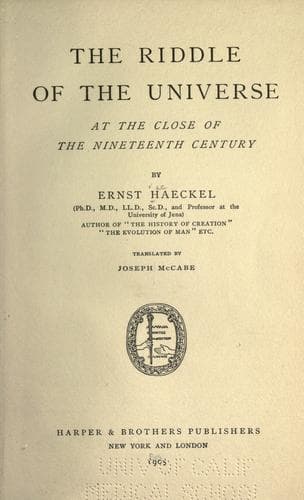
The Riddle of the Universe at the close of the nineteenth centuryHaeckel, Ernst
Religion
The Riddle of the Universe at the close of the nineteenth century
Haeckel, Ernst
Evolution; Monism; Religion and science; Soul
In the midst of this obvious falseness of prevalent pseudo-Christianity
there is one favorable circumstance for the progress of a rational
study of nature: its most powerful and bitterest enemy, the Roman
Church, threw off its mask of ostensible concern for higher mental
development about the middle of the nineteenth century, and declared
a _guerre à l'outrance_ against independent science. This happened
in three important challenges to reason, for the explicitness and
resoluteness of which modern science and culture cannot but be
grateful to the "Vicar of Christ." (1) In December, 1854, the pope
promulgated the dogma of the immaculate conception of Mary. (2) Ten
years afterwards--in December, 1864--the pope published, in his
famous _encyclica_, an absolute condemnation of the whole of modern
civilization and culture; in the _syllabus_ that accompanied it he
enumerated and anathematized all the rational theses and philosophical
principles which are regarded by modern science as lucid truths. (3)
Finally, six years afterwards--on July 13, 1870--the militant head of
the Church crowned his folly by claiming _infallibility_ for himself
and all his predecessors in the papal chair. This triumph of the Roman
_curia_ was communicated to the astonished world five days afterwards,
on the very day on which France declared war with Prussia. Two months
later the temporal power of the pope was taken from him in consequence
of the war.
These three stupendous acts of the papacy were such obvious assaults on
the reason of the nineteenth century that they gave rise, from the very
beginning, to a most heated discussion even within orthodox Catholic
circles. When the Vatican Council proceeded to define the dogma of
infallibility on July 13, 1870, only three-fourths of the bishops
declared in its favor, 451 out of 601 assenting; many other bishops,
who wished to keep clear of the perilous definition, were absent from
the council. But the shrewd pontiff had calculated better than the
timid "discreet Catholics": even this extraordinary dogma was blindly
accepted by the credulous and uneducated masses of the faithful.
Public-domain text, read in full here on John Shaqi.
Reviews
Reviews
No reviews yet
Be the first to share your thoughts on this work.
Elsewhere in the archive
Join the Discussion
Join the discussion
Sign in to leave a comment or review.
Sign InorCreate an account