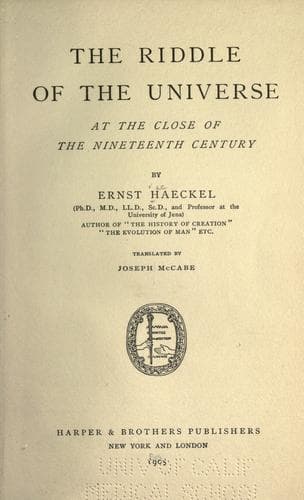
The Riddle of the Universe at the close of the nineteenth centuryHaeckel, Ernst
Religion
The Riddle of the Universe at the close of the nineteenth century
Haeckel, Ernst
Evolution; Monism; Religion and science; Soul
The whole history of the papacy, as it is substantiated by a thousand
reliable sources and accessible documents, appears to the impartial
student as an unscrupulous tissue of lying and deceit, a reckless
pursuit of absolute mental despotism and secular power, a frivolous
contradiction of all the high moral precepts which true Christianity
enunciates--charity and toleration, truth and chastity, poverty and
self-denial. When we judge the long series of popes and of the Roman
princes of the Church, from whom the pope is chosen, by the standard of
pure Christian morality, it is clear that the great majority of them
were pitiful impostors, many of them utterly worthless and vicious.
These well-known historical facts, however, do not prevent millions
of educated Catholics from admitting the infallibility which the pope
has claimed for himself; they do not prevent Protestant princes from
going to Rome, and doing reverence to the pontiff (their most dangerous
enemy); they do not prevent the fate of the German people from being
intrusted to-day to the hands of the servants and followers of this
"pious impostor" in the Reichstag--thanks to the incredible political
indolence and credulity of the nation.
The most interesting of the three great events by which the papacy has
endeavored to maintain and strengthen its despotism in the nineteenth
century is the publication of the encyclica and the syllabus in
December, 1864. In these remarkable documents all independent action
was forbidden to reason and science, and they were commanded to submit
implicitly to faith--that is, to the decrees of the infallible pope.
The great excitement which followed this sublime piece of effrontery in
educated and independent circles was in proportion with the stupendous
contents of the encyclica. Draper has given us an excellent discussion
of its educational and political significance in his _History of the
Conflict between Science and Religion_.
Public-domain text, read in full here on John Shaqi.
Reviews
Reviews
No reviews yet
Be the first to share your thoughts on this work.
Elsewhere in the archive
Join the Discussion
Join the discussion
Sign in to leave a comment or review.
Sign InorCreate an account