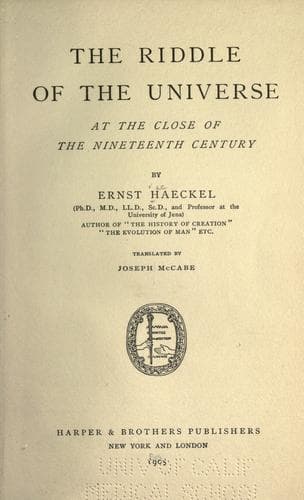
The Riddle of the Universe at the close of the nineteenth centuryHaeckel, Ernst
Religion
The Riddle of the Universe at the close of the nineteenth century
Haeckel, Ernst
Evolution; Monism; Religion and science; Soul
The dogma of the immaculate conception seems, perhaps, to be less
audacious and significant than the encyclica and the dogma of the
infallibility of the pope. Yet not only the Roman hierarchy, but
even some of the orthodox Protestants (the Evangelical Alliance, for
instance), attach great importance to this thesis. What is known
as the "immaculate oath"--that is, the confirmation of faith by an
oath taken on the immaculate conception of Mary--is still regarded by
millions of Christians as a sacred obligation. Many believers take the
dogma in a twofold application; they think that the mother of Mary was
impregnated by the Holy Ghost as well as Mary herself. Comparative and
critical theology has recently shown that this myth has no greater
claim to originality than most of the other stories in the Christian
mythology; it has been borrowed from older religions, especially
Buddhism. Similar myths were widely circulated in India, Persia,
Asia Minor, and Greece several centuries before the birth of Christ.
Whenever a king's unwedded daughter, or some other maid of high degree,
gave birth to a child, the father was always pronounced to be a god, or
a demi-god; in the Christian case it was the Holy Ghost.
The special endowments of mind or body which often distinguished these
"children of love" above ordinary offspring were thus partly explained
by "heredity." Distinguished "sons of God" of this kind were held in
high esteem both in antiquity and during the Middle Ages, while the
moral code of modern civilization reproaches them with their want of
honorable parentage. This applies even more forcibly to "daughters of
God," though the poor maidens are just as little to blame for their
want of a father. For the rest, every one who is familiar with the
beautiful mythology of classical antiquity knows that these sons and
daughters of the Greek and Roman gods often approach nearest to the
highest ideal of humanity. Recollect the large legitimate family, and
the still more numerous illegitimate offspring, of Zeus.
Public-domain text, read in full here on John Shaqi.
Reviews
Reviews
No reviews yet
Be the first to share your thoughts on this work.
Elsewhere in the archive
Join the Discussion
Join the discussion
Sign in to leave a comment or review.
Sign InorCreate an account