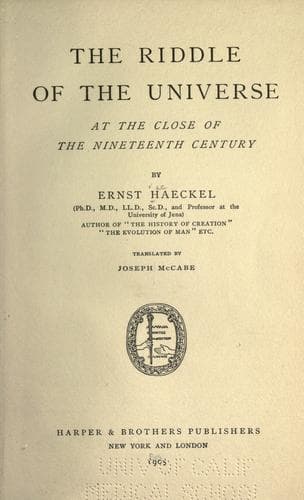
The Riddle of the Universe at the close of the nineteenth centuryHaeckel, Ernst
Religion
The Riddle of the Universe at the close of the nineteenth century
Haeckel, Ernst
Evolution; Monism; Religion and science; Soul
Naturally, these historical details are carefully avoided by the
official theologian, but they assort badly with the traditional myth,
and lift the veil from its mystery in a very simple and natural
fashion. That makes it the more incumbent on impartial research and
pure reason to make a critical examination of these statements. It
must be admitted that they have much more title to credence than all
the other statements about the birth of Christ. When, on familiar
principles of science, we put aside the notion of supernatural
conception through an "overshadowing of the Most High" as a pure myth,
there only remains the widely accepted version of modern rational
theology--that Joseph, the Jewish carpenter, was the true father of
Christ. But this assumption is explicitly contradicted by many texts
of the gospels; Christ himself was convinced that he was a "Son of
God," and he never recognized his foster-father, Joseph, as his real
parent. Joseph, indeed, wanted to leave his betrothed when he found her
pregnant without his interference. He gave up this idea when an angel
appeared to him in a dream and pacified him. As it is expressly stated
in the first chapter of Matthew (vv. 24, 25), there was no sexual
intercourse between Joseph and Mary until after Jesus was born.
The statement of the apocryphal gospels, that the Roman officer,
Pandera, was the true father of Christ, seems all the more credible
when we make a careful anthropological study of the personality
of Christ. He is generally regarded as purely Jewish. Yet the
characteristics which distinguish his high and noble personality,
and which give a distinct impress to his religion, are certainly not
Semitical; they are rather features of the higher Arian race, and
especially of its noblest branch, the Hellenes. Now, the name of
Christ's real father, "Pandera," points unequivocally to a Greek
origin; in one manuscript, in fact, it is written "Pandora." Pandora
was, according to the Greek mythology, the first woman, born of
the earth by Vulcan and adorned with every charm by the gods, who
was espoused by Epimetheus, and sent by Zeus to men with the dread
"Pandora-box," containing every evil, in punishment for the stealing of
divine fire from heaven by Prometheus.
And it is interesting to see the different reception that the
love-story of Miriam has met with at the hands of the four great
Christian nations of civilized Europe. The stern morality of the
Teutonic races entirely repudiates it; the righteous German and the
prudish Briton prefer to believe blindly in the impossible thesis of a
conception "by the Holy Ghost." It is well known that this strenuous
and carefully paraded prudery of the higher classes (especially in
England) is by no means reflected in the true condition of sexual
morality in high quarters. The revelations which the _Pall Mall
Gazette_, for instance, made on the subject twelve years ago vividly
recalled the condition of Babylon.
Public-domain text, read in full here on John Shaqi.
Reviews
Reviews
No reviews yet
Be the first to share your thoughts on this work.
Elsewhere in the archive
Join the Discussion
Join the discussion
Sign in to leave a comment or review.
Sign InorCreate an account