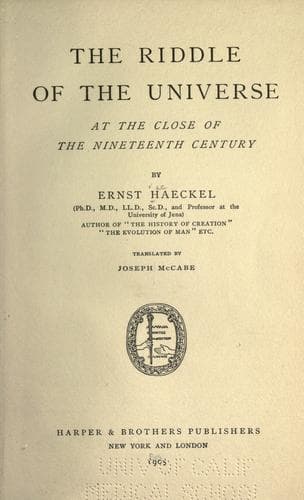
The Riddle of the Universe at the close of the nineteenth centuryHaeckel, Ernst
Religion
The Riddle of the Universe at the close of the nineteenth century
Haeckel, Ernst
Evolution; Monism; Religion and science; Soul
The Romantic races, which ridicule this prudery and take sexual
relations less seriously, find _Mary's Romance_ attractive enough;
the special cult which "Our Lady" enjoys in France and Italy is often
associated with this love-story with curious naïveté. Thus, for
example, Paul de Regla (Dr. Desjardin), author of _Jesus of Nazareth
considered from a Scientific, Historical, and Social Standpoint_
(1894), finds precisely in the illegitimate birth of Christ a special
"title to the halo that irradiates his noble form."
It seemed to me necessary to enter fully into this important question
of the origin of Christ in the sense of impartial historical science,
because the Church militant itself lays great emphasis on it, and
because it regards the miraculous structure which has been founded
on it as one of its strongest weapons against modern thought. The
highest ethical value of pure primitive Christianity and the ennobling
influence of this "religion of love" on the history of civilization are
quite independent of those mythical dogmas. The so-called "revelations"
on which these myths are based are incompatible with the firmest
results of modern science.
CHAPTER XVIII
OUR MONISTIC RELIGION
Monism as a Connecting Link between Religion and Science--The
_Cultur-Kampf_--The Relations of Church and State--Principles
of the Monistic Religion--Its Three-fold Ideal: the Good, the
True, and the Beautiful--Contradiction between Scientific and
Christian Truth--Harmony of the Monistic and the Christian Idea
of Virtue--Opposition between Monistic and Christian Views
of Art--Modern Expansion and Enrichment of Our Idea of the
World--Landscape-Painting and the Modern Enjoyment of Nature--The
Beauties of Nature--This World and Beyond--Monistic Churches
Many distinguished scientists and philosophers of the day, who share
our monistic views, consider that religion is generally played out.
Their meaning is that the clear insight into the evolution of the world
which the great scientific progress of the nineteenth century has
afforded us will satisfy, not only the causal feeling of our reason,
but even our highest emotional cravings. This view is correct in the
sense that the two ideas, religion and science, would indeed blend
into one if we had a perfectly clear and consecutive system of monism.
However, there are but a few resolute thinkers who attain to this most
pure and lofty conception of Spinoza and Goethe. Most of the educated
people of our time (as distinct from the uncultured masses) remain in
the conviction that religion is a separate branch of our mental life,
independent of science, and not less valuable and indispensable.
Public-domain text, read in full here on John Shaqi.
Reviews
Reviews
No reviews yet
Be the first to share your thoughts on this work.
Elsewhere in the archive
Join the Discussion
Join the discussion
Sign in to leave a comment or review.
Sign InorCreate an account