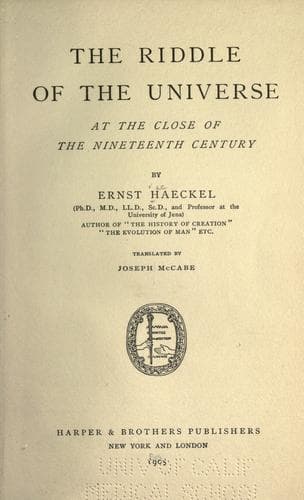
The Riddle of the Universe at the close of the nineteenth centuryHaeckel, Ernst
Religion
The Riddle of the Universe at the close of the nineteenth century
Haeckel, Ernst
Evolution; Monism; Religion and science; Soul
The famous encyclica and syllabus which the militant pope, Pius IX.,
sent out into the entire world in 1864 were a declaration of war on
the whole of modern science; they demanded the blind submission of
reason to the dogmas of the infallible pope. The enormity of this
crude assault on the highest treasures of civilization even roused
many indolent minds from the slumber of belief. Together with the
subsequent promulgation of the papal infallibility (1870), the
encyclica provoked a deep wave of irritation and an energetic repulse
which held out high hopes. In the new German empire, which had attained
its indispensable national unity by the heavy sacrifices of the wars
of 1866 and 1871, the insolent attacks of the pope were felt to be
particularly offensive. On the one hand, Germany is the cradle of
the Reformation and the modern emancipation of reason; on the other
hand, it unfortunately has in its 18,000,000 Catholics a vast host of
militant believers, who are unsurpassed by any other civilized people
in blind obedience to their chief shepherd.
The dangers of such a situation were clearly recognized by the
great statesman who had solved the political "world-riddle" of the
dismemberment of Germany, and had led us by a marvellous statecraft
to the long-desired goal of national unity and power. Prince Bismarck
began the famous struggle with the Vatican, which is known as the
_cultur-kampf_, in 1872, and it was conducted with equal ability and
energy by the distinguished Minister of Worship, Falk, author of the
May laws of 1873. Unfortunately, Bismarck had to desist six years
afterwards. Although the great statesman was a remarkable judge of men
and a realistic politician of immense tact, he had underestimated the
force of three powerful obstacles--first, the unsurpassed cunning and
unscrupulous treachery of the Roman _curia_; secondly, the correlative
ingratitude and credulity of the uneducated Catholic masses, on which
the papacy built; and, thirdly, the power of apathy, the continuance
of the irrational, simply because it is in possession. Hence, in 1878,
when the abler Leo XIII. had ascended the pontifical throne, the fatal
"To Canossa" was heard once more. From that time the newly established
power of Rome grew in strength; partly through the unscrupulous
intrigues and serpentine bends of its slippery Jesuitical politics,
partly through the false Church-politics of the German government and
the marvellous political incompetence of the German people. We have,
therefore, at the close of the nineteenth century to endure the
pitiful spectacle of the Catholic "Centre" being the most important
section of the Reichstag, and the fate of our humiliated country
depending on a papal party, which does not constitute numerically a
third part of the nation.
Public-domain text, read in full here on John Shaqi.
Reviews
Reviews
No reviews yet
Be the first to share your thoughts on this work.
Elsewhere in the archive
Join the Discussion
Join the discussion
Sign in to leave a comment or review.
Sign InorCreate an account