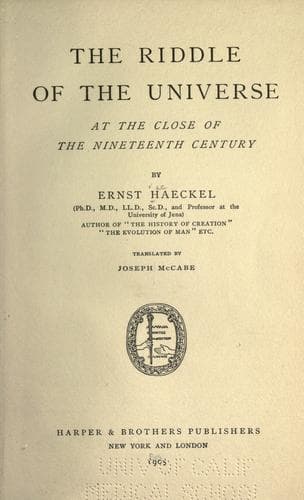
The Riddle of the Universe at the close of the nineteenth centuryHaeckel, Ernst
Religion
The Riddle of the Universe at the close of the nineteenth century
Haeckel, Ernst
Evolution; Monism; Religion and science; Soul
If we adopt this view, we can find a means of reconciling the two
great and apparently quite distinct branches in the idea I put forward
in "Monism, as a Connecting-Link between Religion and Science,"
in 1892. In the preface to this _Confession of Faith of a Man of
Science_ I expressed myself in the following words with regard to
its double object: "In the first place, I must give expression to
the rational system which is logically forced upon us by the recent
progress of science; it dwells in the intimate thoughts of nearly every
impartial and thoughtful scientist, though few have the courage or
the disposition to avow it. In the second place, I would make of it a
connecting-link between religion and science, and thus do away with
the antithesis which has been needlessly maintained between these two
branches of the highest activity of the human mind. The ethical craving
of our emotion is satisfied by monism no less than the logical demand
for causality on the part of reason."
The remarkable interest which the discourse enkindled is a proof that
in this monistic profession of faith I expressed the feeling not only
of many scientists, but of a large number of cultured men and women
of very different circles. Not only was I rewarded by hundreds of
sympathetic letters, but by a wide circulation of the printed address,
of which six editions were required within six months. I had the more
reason to be content with this unexpected success, as this "confession
of faith" was originally merely an occasional speech which I delivered
unprepared on October 9, 1892, at Altenburg, during the jubilee of the
Scientific Society of East Germany. Naturally there was the usual
demonstration on the other side; I was fiercely attacked, not only by
the ultramontane press, the sworn defenders of superstition, but also
by the "liberal" controversialists of evangelical Christianity, who
profess to defend both scientific truth and purified faith. In the
seven years that have ensued since that time the great struggle between
modern science and orthodox Christianity has become more threatening;
it has grown more dangerous for science in proportion as Christianity
has found support in an increasing mental and political reaction. In
some countries the Church has made such progress that the freedom
of thought and conscience, which is guaranteed by the laws, is in
practice gravely menaced (for instance, in Bavaria). The great historic
struggle which Draper has so admirably depicted in his _Conflict
between Religion and Science_ is to-day more acute and significant than
ever. For the last twenty-seven years it has been rightly called the
"_cultur-kampf_."
Public-domain text, read in full here on John Shaqi.
Reviews
Reviews
No reviews yet
Be the first to share your thoughts on this work.
Elsewhere in the archive
Join the Discussion
Join the discussion
Sign in to leave a comment or review.
Sign InorCreate an account