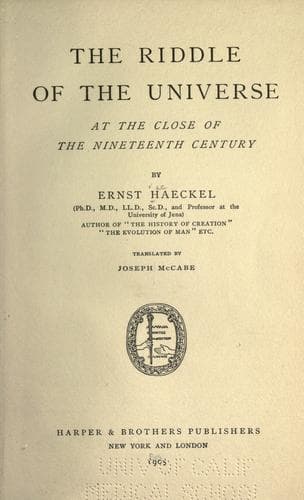
The Riddle of the Universe at the close of the nineteenth centuryHaeckel, Ernst
Religion
The Riddle of the Universe at the close of the nineteenth century
Haeckel, Ernst
Evolution; Monism; Religion and science; Soul
I. The preceding inquiries (especially those of the first and third
sections) have convinced us that truth unadulterated is only to be
found in the temple of the study of nature, and that the only available
paths to it are critical observation and reflection--the empirical
investigation of facts and the rational study of their efficient
causes. In this way we arrive, by means of pure reason, at true
science, the highest treasure of civilized man. We must, in accordance
with the arguments of our sixteenth chapter, reject what is called
"revelation," the poetry of faith, that affirms the discovery of truth
in a supernatural fashion, without the assistance of reason. And since
the entire structure of the Judæo-Christian religion, like that of the
Mohammedan and the Buddhistic, rests on these so-called revelations,
and these mystic fruits of the imagination directly contradict the
clear results of empirical research, it is obvious that we shall
only attain to a knowledge of the truth by the rational activity of
genuine science, not by the poetic imagining of a mystic faith. In this
respect it is quite certain that the Christian system must give way
to the monistic. The goddess of truth dwells in the temple of nature,
in the green woods, on the blue sea, and on the snowy summits of the
hills--not in the gloom of the cloister, nor in the narrow prisons of
our jail-like schools, nor in the clouds of incense of the Christian
churches. The paths which lead to the noble divinity of truth and
knowledge are the loving study of nature and its laws, the observation
of the infinitely great star-world with the aid of the telescope, and
the infinitely tiny cell-world with the aid of the microscope--not
senseless ceremonies and unthinking prayers, not alms and Peter's
Pence. The rich gifts which the goddess of truth bestows on us are the
noble fruits of the tree of knowledge and the inestimable treasure of a
clear, unified view of the world--not belief in supernatural miracles
and the illusion of an eternal life.
Public-domain text, read in full here on John Shaqi.
Reviews
Reviews
No reviews yet
Be the first to share your thoughts on this work.
Elsewhere in the archive
Join the Discussion
Join the discussion
Sign in to leave a comment or review.
Sign InorCreate an account