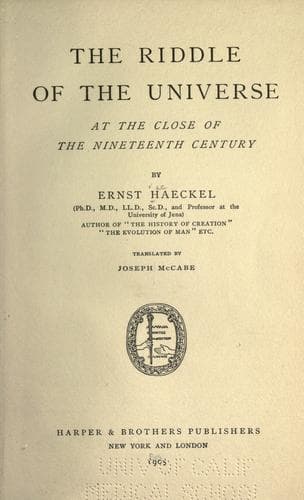
The Riddle of the Universe at the close of the nineteenth centuryHaeckel, Ernst
Religion
The Riddle of the Universe at the close of the nineteenth century
Haeckel, Ernst
Evolution; Monism; Religion and science; Soul
II. It is otherwise with the divine ideal of eternal goodness. In our
search for the truth we have entirely to exclude the "revelation" of
the churches, and devote ourselves solely to the study of nature; but,
on the other hand, the idea of the good, which we call virtue, in
our monistic religion coincides for the most part with the Christian
idea of virtue. We are speaking, naturally, of the primitive and
pure Christianity of the first three centuries, as far as we learn
its moral teaching from the gospels and the epistles of Paul; it
does not apply to the Vatican caricature of that pure doctrine which
has dominated European civilization, to its infinite prejudice, for
twelve hundred years. The best part of Christian morality, to which we
firmly adhere, is represented by the humanist precepts of charity and
toleration, compassion and assistance. However, these noble commands,
which are set down as "Christian" morality (in its best sense), are by
no means original discoveries of Christianity; they are derived from
earlier religions. The Golden Rule, which sums up these precepts in
one sentence, is centuries older than Christianity. In the conduct of
life this law of natural morality has been followed just as frequently
by non-Christians and atheists as it has been neglected by pious
believers. Moreover, Christian ethics was marred by the great defect
of a narrow insistence on altruism and a denunciation of egoism. Our
monistic ethics lays equal emphasis on the two, and finds perfect
virtue in the just balance of love of self and love of one's neighbor
(cf. chap. xix.).
III. But monism enters into its strongest opposition to Christianity
on the question of beauty. Primitive Christianity preached the
worthlessness of earthly life, regarding it merely as a preparation
for an eternal life beyond. Hence it immediately followed that all we
find in the life of man here below, all that is beautiful in art and
science, in public and in private life, is of no real value. The true
Christian must avert his eyes from them; he must think only of a worthy
preparation for the life beyond. Contempt of nature, aversion from all
its inexhaustible charms, rejection of every kind of fine art, are
Christian duties; and they are carried out to perfection when a man
separates himself from his fellows, chastises his body, and spends all
his time in prayer in the cloister or the hermit's cell.
Public-domain text, read in full here on John Shaqi.
Reviews
Reviews
No reviews yet
Be the first to share your thoughts on this work.
Elsewhere in the archive
Join the Discussion
Join the discussion
Sign in to leave a comment or review.
Sign InorCreate an account