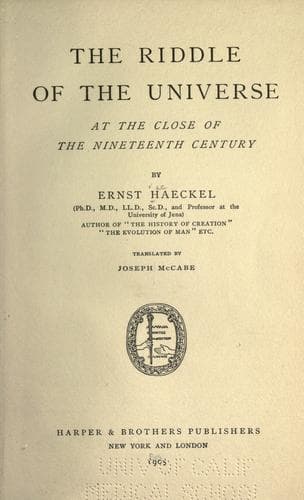
The Riddle of the Universe at the close of the nineteenth centuryHaeckel, Ernst
Religion
The Riddle of the Universe at the close of the nineteenth century
Haeckel, Ernst
Evolution; Monism; Religion and science; Soul
The equal appreciation of these two natural impulses, or the moral
equivalence of self-love and love of others, is the chief and the
fundamental principle of our morality. Hence the highest aim of all
ethics is very simple--it is the re-establishment of "the natural
equality of egoism and altruism, of the love of one's self and the
love of one's neighbor." The Golden Rule says: "Do unto others as you
would that they should do unto you." From this highest precept of
Christianity it follows of itself that we have just as sacred duties
towards ourselves as we have towards our fellows. I have explained
my conception of this principle in my _Monism_, and laid down three
important theses. (1) Both these concurrent impulses are natural
laws, of equal importance and necessity for the preservation of the
family and the society; egoism secures the self-preservation of the
individual, altruism that of the species which is made up of the chain
of perishable individuals. (2) The social duties which are imposed
by the social structure of the associated individuals, and by means
of which it secures its preservation, are merely higher evolutionary
stages of the social instincts, which we find in all higher social
animals (as "habits which have become hereditary"). (3) In the case of
civilized man all ethics, theoretical or practical, being "a science
of rules," is connected with his view of the world at large, and
consequently with his religion.
From the recognition of the fundamental principle of our morality
we may immediately deduce its highest precept, that noble command,
which is often called the Golden Rule of morals, or, briefly, the
Golden Rule. Christ repeatedly expressed it in the simple phrase:
"Thou shalt love thy neighbor as thyself." Mark adds that "there is
no greater commandment than this," and Matthew says: "In these two
commandments is the whole law and the prophets." In this greatest and
highest commandment our monistic ethics is completely at one with
Christianity. We must, however, recall the historical fact that the
formulation of this supreme command is not an original merit of Christ,
as the majority of Christian theologians affirm and their uncritical
supporters blindly accept. The Golden Rule is five hundred years
older than Christ; it was laid down as the highest moral principle by
many Greek and Oriental sages. Pittacus, of Mylene, one of the seven
wise men of Greece, said six hundred and twenty years before Christ:
"Do not that to thy neighbor that thou wouldst not suffer from him."
Confucius, the great Chinese philosopher and religious founder (who
rejected the idea of a personal God and of the immortality of the
soul), said five hundred years B.C.: "Do to every man as thou wouldst
have him do to thee; and do not to another what thou wouldst not have
him do to thee. This precept only dost thou need; it is the foundation
of all other commandments." Aristotle taught about the middle of the
Public-domain text, read in full here on John Shaqi.
Reviews
Reviews
No reviews yet
Be the first to share your thoughts on this work.
Elsewhere in the archive
Join the Discussion
Join the discussion
Sign in to leave a comment or review.
Sign InorCreate an account