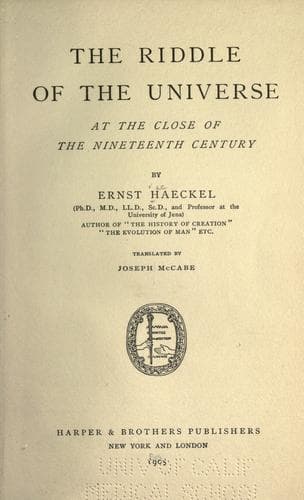
The Riddle of the Universe at the close of the nineteenth centuryHaeckel, Ernst
Religion
The Riddle of the Universe at the close of the nineteenth century
Haeckel, Ernst
Evolution; Monism; Religion and science; Soul
Although the obvious contradiction of the two forms of reason in Kant's
teaching, the fundamental antagonism of pure and practical reason, was
recognized and attacked at the very beginning of the century, it is
still pretty widely accepted. The modern school of neo-Kantians urges a
"return to Kant" so pressingly precisely on account of this agreeable
dualism; the Church militant zealously supports it because it fits
in admirably with its own mystic faith. But it met with an effective
reverse at the hands of modern science in the second half of the
nineteenth century, which entirely demolished the theses of the system
of practical reason. Monistic cosmology proved, on the basis of the law
of substance, that there is no personal God; comparative and genetic
psychology showed that there cannot be an immortal soul; and monistic
physiology proved the futility of the assumption of "free will."
Finally, the science of evolution made it clear that the same eternal
iron laws that rule in the inorganic world are valid too in the organic
and moral world.
But modern science gives not only a negative support to practical
philosophy and ethics in demolishing the Kantian dualism, but it
renders the positive service of substituting for it the new structure
of ethical monism. It shows that the feeling of duty does not rest
on an illusory "categorical imperative," but on the solid ground of
_social instinct_, as we find in the case of all social animals. It
regards as the highest aim of all morality the re-establishment of a
sound harmony between egoism and altruism, between self-love and the
love of one's neighbor. It is to the great English philosopher, Herbert
Spencer, that we owe the founding of this monistic ethics on a basis of
evolution.
Man belongs to the social vertebrates, and has, therefore, like all
social animals, two sets of duties--first to himself, and secondly
to the society to which he belongs. The former are the behests of
self-love or egoism, the latter of love for one's fellows or altruism.
The two sets of precepts are equally just, equally natural, and equally
indispensable. If a man desire to have the advantage of living in an
organized community, he has to consult not only his own fortune, but
also that of the society, and of the "neighbors" who form the society.
He must realize that its prosperity is his own prosperity, and that it
cannot suffer without his own injury. This fundamental law of society
is so simple and so inevitable that one cannot understand how it can be
contradicted in theory or in practice; yet that is done to-day, and has
been done for thousands of years.
Public-domain text, read in full here on John Shaqi.
Reviews
Reviews
No reviews yet
Be the first to share your thoughts on this work.
Elsewhere in the archive
Join the Discussion
Join the discussion
Sign in to leave a comment or review.
Sign InorCreate an account