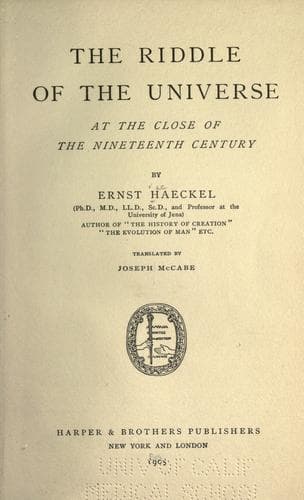
The Riddle of the Universe at the close of the nineteenth centuryHaeckel, Ernst
Religion
The Riddle of the Universe at the close of the nineteenth century
Haeckel, Ernst
Evolution; Monism; Religion and science; Soul
I. The supreme mistake of Christian ethics, and one which runs
directly counter to the Golden Rule, is its exaggeration of love of
one's neighbor at the expense of self-love. Christianity attacks and
despises egoism on principle. Yet that natural impulse is absolutely
indispensable in view of self-preservation; indeed, one may say that
even altruism, its apparent opposite, is only an enlightened egoism.
Nothing great or elevated has ever taken place without egoism, and
without the passion that urges us to great sacrifices. It is only
the excesses of the impulse that are injurious. One of the Christian
precepts that were impressed upon us in our early youth as of great
importance, and that are glorified in millions of sermons, is: "Love
your enemies, bless them that curse you, do good to them that hate you,
and pray for them which despitefully use you and persecute you." It is
a very ideal precept, but as useless in practice as it is unnatural.
So it is with the counsel, "If any man will take away thy coat, let
him have thy cloak also." Translated into the terms of modern life,
that means: "When some unscrupulous scoundrel has defrauded thee of
half thy goods, let him have the other half also." Or, again, in the
language of modern politics: "When the pious English take from you
simple Germans one after another of your new and valuable colonies in
Africa, let them have all the rest of your colonies also--or, best of
all, give them Germany itself." And, while we touch on the marvellous
world-politics of modern England, we may note in passing its direct
contradiction of every precept of Christian charity, which is more
frequently on the lips of that great nation than of any other nation in
the world. However, the glaring contradiction between the theoretical,
_ideal_, altruistic morality of the human individual and the _real_,
purely selfish morality of the human community, and especially of the
civilized Christian state, is a familiar fact. It would be interesting
to determine mathematically in what proportion among organized men the
altruistic ethical ideal of the individual changes into its contrary,
the purely egoistic "real politics" of the state and the nation.
Public-domain text, read in full here on John Shaqi.
Reviews
Reviews
No reviews yet
Be the first to share your thoughts on this work.
Elsewhere in the archive
Join the Discussion
Join the discussion
Sign in to leave a comment or review.
Sign InorCreate an account