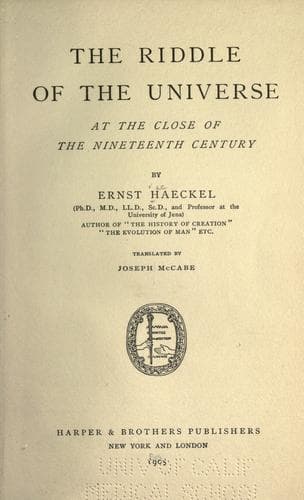
The Riddle of the Universe at the close of the nineteenth centuryHaeckel, Ernst
Religion
The Riddle of the Universe at the close of the nineteenth century
Haeckel, Ernst
Evolution; Monism; Religion and science; Soul
II. Since the Christian faith takes a wholly dualistic view of the
human organism and attributes to the immortal soul only a temporary
sojourn in the mortal frame, it very naturally sets a much greater
value on the soul than on the body. Hence results that neglect of the
care of the body, of training, and of cleanliness which contrasts the
life of the Christian Middle Ages so unfavorably with that of pagan
classical antiquity. Christian ethics contains none of those firm
commands as to daily ablutions which are theoretically laid down and
practically fulfilled in the Mohammedan, Hindoo, and other religions.
In many monasteries the ideal of the pious Christian is the man who
does not wash and clothe himself properly, who never changes his
malodorous gown, and who, instead of regular work, fills up his useless
life with mechanical prayers, senseless fasts, and so forth. As a
special outgrowth of this contempt of the body we have the disgusting
discipline of the flagellants and other ascetics.
III. One source of countless theoretical errors and practical
blemishes, of deplorable crudity and privation, is found in the false
anthropism of Christianity--that is, in the unique position which
it gives to man, as the image of God, in opposition to all the rest
of nature. In this way it has contributed, not only to an extremely
injurious isolation from our glorious mother "nature," but also to
a regrettable contempt of all other organisms. Christianity has no
place for that well-known love of animals, that sympathy with the
nearly related and friendly mammals (dogs, horses, cattle, etc.),
which is urged in the ethical teaching of many of the older religions,
especially Buddhism. Whoever has spent much time in the south of Europe
must have often witnessed those frightful sufferings of animals which
fill us friends of animals with the deepest sympathy and indignation.
And when one expostulates with these brutal "Christians" on their
cruelty, the only answer is, with a laugh: "But the beasts are not
Christians." Unfortunately Descartes gave some support to the error in
teaching that man only has a sensitive soul, not the animal.
How much more elevated is our monistic ethics than the Christian in
this regard! Darwinism teaches us that we have descended immediately
from the primates, and, in a secondary degree, from a long series
of earlier mammals, and that, therefore, they are "our brothers";
physiology informs us that they have the same nerves and sense-organs
as we, and the same feelings of pleasure and pain. No sympathetic
monistic scientist would ever be guilty of that brutal treatment of
animals which comes so lightly to the Christian in his anthropistic
illusion--to the "child of the God of love." Moreover, this Christian
contempt of nature on principle deprives man of an abundance of the
highest earthly joys, especially of the keen, ennobling enjoyment of
nature.
Public-domain text, read in full here on John Shaqi.
Reviews
Reviews
No reviews yet
Be the first to share your thoughts on this work.
Elsewhere in the archive
Join the Discussion
Join the discussion
Sign in to leave a comment or review.
Sign InorCreate an account