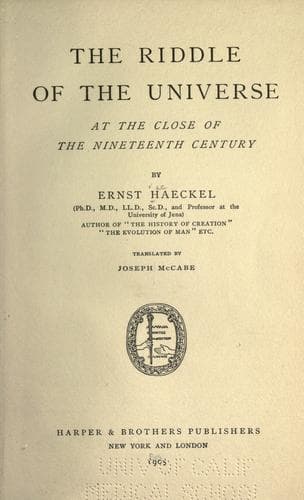
The Riddle of the Universe at the close of the nineteenth centuryHaeckel, Ernst
Religion
The Riddle of the Universe at the close of the nineteenth century
Haeckel, Ernst
Evolution; Monism; Religion and science; Soul
VI. As Christ never knew the love of woman, he had no personal
acquaintance with that refining of man's true nature that comes only
from the intimate life of man with woman. The intimate sexual union, on
which the preservation of the human race depends, is just as important
on that account as the spiritual penetration of the two sexes, or
the mutual complement which they bring to each other in the practical
wants of daily life as well as in the highest ideal functions of the
soul. For man and woman are two different organisms, equal in worth,
each having its characteristic virtues and defects. As civilization
advanced, this ideal value of sexual love was more appreciated, and
woman held in higher honor, especially among the Teutonic races; she
is the inspiring source of the highest achievements of art and poetry.
But Christ was as far from this view as nearly the whole of antiquity;
he shared the idea that prevailed everywhere in the East--that
woman is subordinate to man, and intercourse with her is "unclean."
Long-suffering nature has taken a fearful revenge for this blunder; its
sad consequences are written in letters of blood in the history of the
papal Middle Ages.
The marvellous hierarchy of the Roman Church, that never disdained any
means of strengthening its spiritual despotism, found an exceptionally
powerful instrument in the manipulation of this "unclean" idea, and in
the promotion of the ascetic notion that abstinence from intercourse
with women is a virtue of itself. In the first few centuries after
Christ a number of priests voluntarily abstained from marriage, and
the supposed value of this celibacy soon rose to such a degree that it
was made obligatory. In the Middle Ages the seduction of women of good
repute and of their daughters by Catholic priests (the confessional
was an active agency in the business) was a public scandal: many
communities, in order to prevent such things, pressed for a license
of concubinage to be given to the clergy. And it was done in many,
and sometimes very romantic, ways. Thus, for instance, the canon law
that the priest's cook should not be less than forty years old was
very cleverly "explained" in the sense that the priest might have two
cooks, one in the presbytery, another without; if one was twenty-four
and the other eighteen, that made forty-two together--two years above
the prescribed age. At the Christian councils, at which heretics were
burned alive, the cardinals and bishops sat down with whole troops
of prostitutes. The private and public debauchery of the Catholic
clergy was so scandalous and dangerous to the commonwealth that there
was a general rebellion against it before the time of Luther, and a
loud demand for a "reformation of the church in head and members." It
is well known that these immoral relations still continue in Roman
Catholic lands, although more in secret. Formerly proposals were
made from time to time for the definitive abrogation of celibacy, as
Public-domain text, read in full here on John Shaqi.
Reviews
Reviews
No reviews yet
Be the first to share your thoughts on this work.
Elsewhere in the archive
Join the Discussion
Join the discussion
Sign in to leave a comment or review.
Sign InorCreate an account