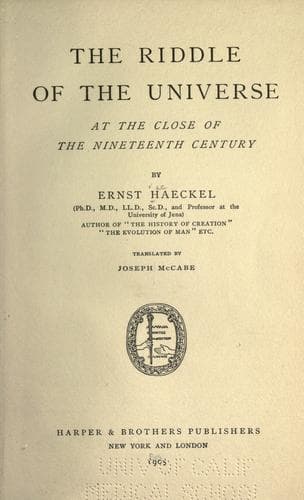
The Riddle of the Universe at the close of the nineteenth centuryHaeckel, Ernst
Religion
The Riddle of the Universe at the close of the nineteenth century
Haeckel, Ernst
Evolution; Monism; Religion and science; Soul
IV. Since, according to Christ's teaching, our planet is "a vale of
tears," and our earthly life is valueless and a mere preparation for a
better life to come, it has succeeded in inducing men to sacrifice all
happiness on this side of eternity and make light of all earthly goods.
Among these "earthly goods," in the case of the modern civilized man,
we must include the countless great and small conveniences of technical
science, hygiene, commerce, etc., which have made modern life cheerful
and comfortable; we must include all the gratifications of painting,
sculpture, music, and poetry, which flourished exceedingly even during
the Middle Ages (in spite of its principles), and which we esteem
as "ideal pleasures"; we must include all that invaluable progress
of science, especially the study of nature, of which the nineteenth
century is justly proud. All these "earthly goods," that have so high a
value in the eyes of the monist, are worthless--nay, injurious--for the
most part, according to Christian teaching; the stern code of Christian
morals should look just as unfavorably on the pursuit of these
pleasures as our humanistic ethics fosters and encourages it. Once
more, therefore, Christianity is found to be an enemy to civilization,
and the struggle which modern thought and science are compelled to
conduct with it is, in this additional sense, a "_cultur-kampf_."
V. Another of the most deplorable aspects of Christian morality is
its belittlement of the life of the family, of that natural living
together with our next of kin which is just as necessary in the case
of man as in the case of all the higher social animals. The family
is justly regarded as the "foundation of society," and the healthy
life of the family is a necessary condition of the prosperity of the
State. Christ, however, was of a very different opinion: with his gaze
ever directed to "the beyond," he thought as lightly of woman and the
family as of all other goods of "this life." Of his infrequent contact
with his parents and sisters the gospels have very little to say; but
they are far from representing his relations with his mother to have
been so tender and intimate as they are poetically depicted in so many
thousands of pictures. He was not married himself. Sexual love, the
first foundation of the family union, seems to have been regarded by
Jesus as a necessary evil. His most enthusiastic apostle, Paul, went
still farther in the same direction, declaring it to be better not to
marry than to marry: "It is good for a man not to touch a woman." If
humanity were to follow this excellent counsel, it would soon be rid
of all earthly misery and suffering: it would be killed off by such a
"radical cure" within half a century.
Public-domain text, read in full here on John Shaqi.
Reviews
Reviews
No reviews yet
Be the first to share your thoughts on this work.
Elsewhere in the archive
Join the Discussion
Join the discussion
Sign in to leave a comment or review.
Sign InorCreate an account