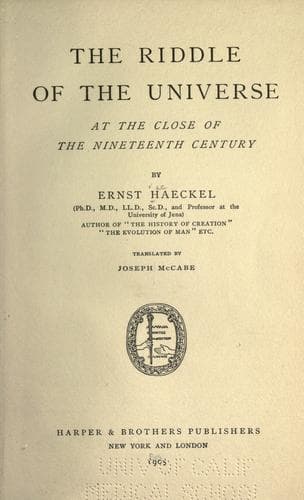
The Riddle of the Universe at the close of the nineteenth centuryHaeckel, Ernst
Religion
The Riddle of the Universe at the close of the nineteenth century
Haeckel, Ernst
Evolution; Monism; Religion and science; Soul
In the great _cultur-kampf_, which must go on as long as these sad
conditions exist, the first aim must be the absolute separation of
Church and State. There shall be "a free Church in a free State"--that
is, every Church shall be free in the practice of its special worship
and ceremonies, and in the construction of its fantastic poetry and
superstitious dogmas--with the sole condition that they contain no
danger to social order or morality. Then there will be equal rights
for all. Free societies and monistic religious bodies shall be equally
tolerated, and just as free in their movements as Liberal Protestant
and orthodox ultramontane congregations. But for all these "faithful"
of the most diverse sects religion will have to be a private concern.
The state shall supervise them, and prevent excesses; but it must
neither oppress nor support them. Above all, the ratepayers shall not
be compelled to contribute to the support and spread of a "faith" which
they honestly believe to be a harmful superstition. In the United
States such a complete separation of Church and State has been long
accomplished, greatly to the satisfaction of all parties. They have
also the equally important separation of the Church from the school;
that is, undoubtedly, a powerful element in the great advance which
science and culture have recently made in America.
It goes without saying that this exclusion of the Church from the
school only refers to its sectarian principles, the particular form
of belief which each Church has evolved in the course of its life.
This sectarian education is purely a private concern, and should be
left to parents and tutors, or to such priests or teachers as may
have the personal confidence of the parents. Instead of the rejected
sectarian instruction, two important branches of education will be
introduced--monistic or humanist ethics and comparative religion.
During the last thirty years an extensive literature has appeared
dealing with the new system of ethics which has been raised on the
basis of modern science--especially evolutionary science. Comparative
religion will be a natural companion to the actual elementary
instruction in "biblical history" and in the mythology of Greece and
Rome. Both of these will remain in the curriculum. The reason for
that is obvious enough; the whole of our painting and sculpture, the
chief branches of monistic æsthetics, are intimately blended with
the Christian, Greek, and Roman mythologies. There will only be this
important difference--that the Christian myths and legends will not
be taught as truths, but as poetic fancies, like the Greek and Roman
myths; the high value of the ethical and æsthetical material they
contain will not be lessened, but increased, by this means. As regards
the Bible, the "book of books" will only be given to the children in
carefully selected extracts (a sort of "school Bible"); in this way we
shall avoid the besmirching of the child's imagination with the unclean
Public-domain text, read in full here on John Shaqi.
Reviews
Reviews
No reviews yet
Be the first to share your thoughts on this work.
Elsewhere in the archive
Join the Discussion
Join the discussion
Sign in to leave a comment or review.
Sign InorCreate an account