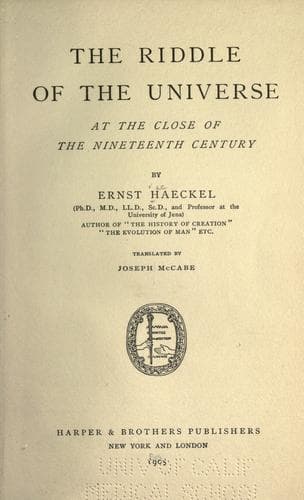
The Riddle of the Universe at the close of the nineteenth centuryHaeckel, Ernst
Religion
The Riddle of the Universe at the close of the nineteenth century
Haeckel, Ernst
Evolution; Monism; Religion and science; Soul
stories and passages which are so numerous in the Old Testament.
Once the modern State has freed itself and its schools from the
fetters of the Church, it will be able to devote more attention to the
improvement of education. The incalculable value of a good system of
education has forced itself more and more upon us as the many aspects
of modern civilized life have been enlarged and enriched in the
course of the century. But the development of the educational methods
has by no means kept pace with life in general. The necessity for a
comprehensive reform of our schools is making itself felt more and
more. On this question, too, a number of valuable works have appeared
in the course of the last forty years. We shall restrict ourselves to
making a few general observations which we think of special importance.
1. In all education up to the present time _man_ has played the chief
part, and especially the grammatical study of his language; the study
of _nature_ was entirely neglected.
2. In the school of the future nature will be the chief object of the
study; a man shall learn a correct view of the world he lives in; he
will not be made to stand outside of and opposed to nature, but be
represented as its highest and noblest product.
3. The study of the classical tongues (Latin and Greek), which has
hitherto absorbed most of the pupils' time and energy, is indeed
valuable; but it will be much restricted, and confined to the mere
elements (obligatory for Latin, optional for Greek).
4. In consequence, modern languages must be all the more cultivated in
all the higher schools (English and French to be obligatory, Italian
optional).
5. Historical instruction must pay more attention to the inner
mental and spiritual life of a nation, and to the development of its
civilization, and less to its external history (the vicissitudes of
dynasties, wars, and so forth).
6. The elements of evolutionary science must be learned in conjunction
with cosmology, geology must go with geography, and anthropology with
biology.
7. The first principles of biology must be familiar to every educated
man; the modern training in observation furnishes an attractive
introduction to the biological sciences (anthropology, zoology, and
botany). A start must be made with descriptive system (in conjunction
with ætiology or bionomy); the elements of anatomy and physiology to be
added later on.
8. The first principles of physics and chemistry must also be taught,
and their exact establishment with the aid of mathematics.
9. Every pupil must be taught to draw well, and from nature; and,
wherever it is possible, the use of water-colors. The execution of
drawings and of water-color sketches from nature (of flowers, animals,
landscapes, clouds, etc.) not only excites interest in nature and helps
memory to enjoy objects, but it gives the pupil his first lesson in
_seeing_ correctly and understanding what he has seen.
Public-domain text, read in full here on John Shaqi.
Reviews
Reviews
No reviews yet
Be the first to share your thoughts on this work.
Elsewhere in the archive
Join the Discussion
Join the discussion
Sign in to leave a comment or review.
Sign InorCreate an account