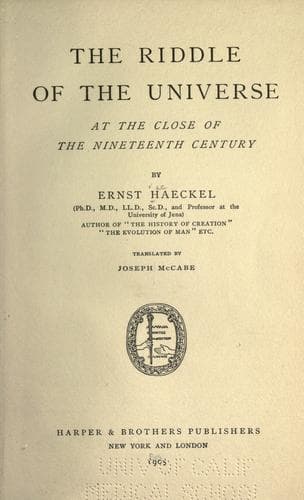
The Riddle of the Universe at the close of the nineteenth centuryHaeckel, Ernst
Religion
The Riddle of the Universe at the close of the nineteenth century
Haeckel, Ernst
Evolution; Monism; Religion and science; Soul
The heated conflict of these "Neptunian" and "Plutonic" schools was
still going on during the first three decades of the present century;
it was only settled when Karl Hoff (1822) established the principle of
"actualism," and Sir Charles Lyell applied it with signal success to
the entire natural evolution of the earth. The _Principles of Geology_
of Lyell (1830) secured the full recognition of the supremely important
theory of continuity in the formation of the earth's crust, as opposed
to the catastrophic theory of Cuvier.[34] Palæontology, which had
been founded by Cuvier's work on fossil bones (1812), was of the
greatest service to geology; by the middle of the present century it
had advanced so far that the chief periods in the history of the earth
and its inhabitants could be established. The comparatively thin crust
of the earth was now recognized with certainty to be the hard surface
formed by the cooling of an incandescent fluid planet, which still
continues its slow, unbroken course of refrigeration and condensation.
The crumpling of the stiffened crust, "the reaction of the molten fiery
contents on the cool surface," and especially the unceasing geological
action of water, are the natural causes which are daily at work in the
secular formation of the crust of the earth and its mountains.
To the brilliant progress of modern geology we owe three extremely
important results of general import. In the first place, it has
excluded from the story of the earth all questions of miracle, all
questions of supernatural agencies, in the building of the mountains
and the shaping of the continents. In the second place, our idea of
the length of the vast period of time which had been absorbed in their
formation has been considerably enlarged. We now know that the huge
mountains of the palæozoic, mesozoic, and cenozoic formations have
taken, not thousands, but millions of years in their growth. In the
third place, we now know that all the countless fossils that are found
in those formations are not "sports of nature," as was believed one
hundred and fifty years ago, but the petrified remains of organisms
that lived in earlier periods of the earth's history, and arose by
gradual transformation from a long series of ancestors.
III.--PROGRESS OF PHYSICS AND CHEMISTRY
Public-domain text, read in full here on John Shaqi.
Reviews
Reviews
No reviews yet
Be the first to share your thoughts on this work.
Elsewhere in the archive
Join the Discussion
Join the discussion
Sign in to leave a comment or review.
Sign InorCreate an account