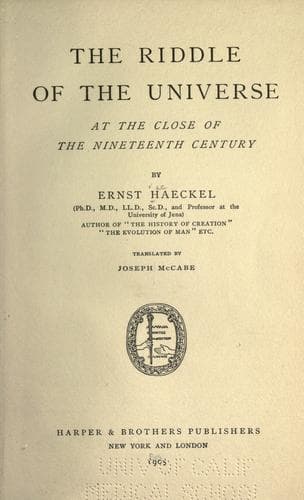
The Riddle of the Universe at the close of the nineteenth centuryHaeckel, Ernst
Religion
The Riddle of the Universe at the close of the nineteenth century
Haeckel, Ernst
Evolution; Monism; Religion and science; Soul
The earth and its origin were much later than the heavens in becoming
the object of scientific investigation. The numerous ancient and modern
cosmogonies do, indeed, profess to give us as good an insight into the
origin of the earth as into that of the heavens; but the mythological
raiment, in which all alike are clothed, betrays their origin in
poetic fancy. Among the countless legends of creation which we find in
the history of religions and of thought there is one that soon took
precedence of all the rest--the Mosaic story of creation as told in
the first book of the Hexateuch. It did not exist in its present form
until long after the death of Moses (probably not until eight hundred
years afterwards); but its sources are much older, and are to be found
for the most part in Assyrian, Babylonian, and Hindoo legends. This
Hebrew legend of creation obtained its great influence through its
adoption into the Christian faith and its consecration as the "Word of
God." Greek philosophers had already, five hundred years before Christ,
explained the natural origin of the earth in the same way as that of
other cosmic bodies. Xenophanes of Colophon had even recognized the
true character of the fossils which were afterwards to prove of such
moment; the great painter, Leonardo da Vinci, of the fifteenth century,
also explained the fossils as the petrified remains of animals which
had lived in earlier periods of the earth's history. But the authority
of the Bible, especially the myth of the deluge, prevented any further
progress in this direction, and insured the triumph of the Mosaic
legend until about the middle of the last century. It survives even at
the present day among orthodox theologians. However, in the second half
of the eighteenth century, scientific inquiry into the structure of the
crust of the earth set to work independently of the Mosaic story, and
it soon led to certain conclusions as to the origin of the earth. The
founder of geology, Werner of Freiberg, thought that all the rocks were
formed in water, while Voigt and Hutton (1788) rightly contended that
only the stratified, fossil-bearing rocks had had an aquatic origin,
and that the Vulcanic or Plutonic mountain ranges had been formed by
the cooling down of molten matter.
Public-domain text, read in full here on John Shaqi.
Reviews
Reviews
No reviews yet
Be the first to share your thoughts on this work.
Elsewhere in the archive
Join the Discussion
Join the discussion
Sign in to leave a comment or review.
Sign InorCreate an account