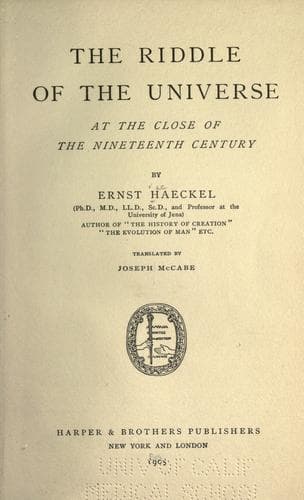
The Riddle of the Universe at the close of the nineteenth centuryHaeckel, Ernst
Religion
The Riddle of the Universe at the close of the nineteenth century
Haeckel, Ernst
Evolution; Monism; Religion and science; Soul
The answer to this final question naturally varies considerably
according to the stand-point of the philosophic inquirer and his
empirical acquaintance with the real world. We grant at once that the
innermost character of nature is just as little understood by us as it
was by Anaximander and Empedocles twenty-four hundred years ago, by
Spinoza and Newton two hundred years ago, and by Kant and Goethe one
hundred years ago. We must even grant that this essence of substance
becomes more mysterious and enigmatic the deeper we penetrate into the
knowledge of its attributes, matter and energy, and the more thoroughly
we study its countless phenomenal forms and their evolution. We do not
know the "thing in itself" that lies behind these knowable phenomena.
But why trouble about this enigmatic "thing in itself" when we have
no means of investigating it, when we do not even clearly know whether
it exists or not? Let us, then, leave the fruitless brooding over this
ideal phantom to the "pure metaphysician," and let us instead, as "real
physicists," rejoice in the immense progress which has been actually
made by our monistic philosophy of nature.
Towering above all the achievements and discoveries of the century
we have the great, comprehensive "law of substance," the fundamental
law of the constancy of matter and force. The fact that substance is
everywhere subject to eternal movement and transformation gives it the
character also of the universal law of evolution. As this supreme law
has been firmly established, and all others are subordinate to it, we
arrive at a conviction of the universal unity of nature and the eternal
validity of its laws. From the gloomy _problem_ of substance we have
evolved the clear _law_ of substance. The monism of the cosmos which we
establish thereon proclaims the absolute dominion of "the great eternal
iron laws" throughout the universe. It thus shatters, at the same time,
the three central dogmas of the dualistic philosophy--the personality
of God, the immortality of the soul, and the freedom of the will.
Many of us certainly view with sharp regret, or even with a profound
sorrow, the death of the gods that were so much to our parents and
ancestors. We must console ourselves in the words of the poet:
"The times are changed, old systems fall,
And new life o'er their ruins dawns."
The older view of idealistic dualism is breaking up with all its mystic
and anthropistic dogmas; but upon the vast field of ruins rises,
majestic and brilliant, the new sun of our realistic monism, which
reveals to us the wonderful temple of nature in all its beauty. In the
sincere cult of "the true, the good, and the beautiful," which is the
heart of our new monistic religion, we find ample compensation for the
anthropistic ideals of "God, freedom, and immortality" which we have
lost.
Public-domain text, read in full here on John Shaqi.
Reviews
Reviews
No reviews yet
Be the first to share your thoughts on this work.
Elsewhere in the archive
Join the Discussion
Join the discussion
Sign in to leave a comment or review.
Sign InorCreate an account