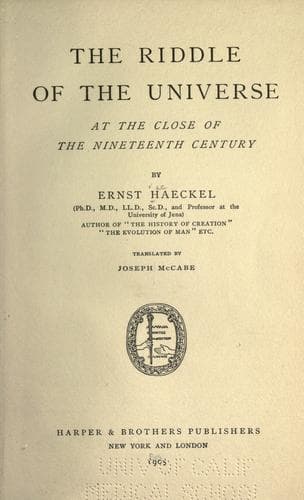
The Riddle of the Universe at the close of the nineteenth centuryHaeckel, Ernst
Religion
The Riddle of the Universe at the close of the nineteenth century
Haeckel, Ernst
Evolution; Monism; Religion and science; Soul
Throughout this discussion of the riddles of the universe I have
clearly defined my consistent monistic position and its opposition
to the still prevalent dualistic theory. In this I am supported by
the agreement of nearly all modern scientists who have the courage to
accept a rounded philosophical system. I must not, however, take leave
of my readers without pointing out in a conciliatory way that this
strenuous opposition may be toned down to a certain degree on clear
and logical reflection--may, indeed, even be converted into a friendly
harmony. In a thoroughly logical mind, applying the highest principles
with equal force in the entire field of the cosmos--in both organic and
inorganic nature--the antithetical positions of theism and pantheism,
vitalism and mechanism, approach until they touch each other.
Unfortunately, consecutive thought is a rare phenomenon in nature. The
great majority of philosophers are content to grasp with the right hand
the pure knowledge that is built on experience, but they will not part
with the mystic faith based on revelation, to which they cling with the
left. The best type of this contradictory dualism is the conflict of
pure and practical reason in the critical philosophy of the most famous
of modern thinkers, Immanuel Kant.
On the other hand, the number is always small of the thinkers who
will boldly reject dualism and embrace pure monism. That is equally
true of consistent idealists and theists, and of logical realists and
pantheists. However, the reconciliation of these apparent antitheses,
and, consequently, the advance towards the solution of the fundamental
riddle of the universe, is brought nearer to us every year in the
ever-increasing growth of our knowledge of nature. We may, therefore,
express a hope that the approaching twentieth century will complete
the task of resolving the antitheses, and, by the construction of a
system of pure monism, spread far and wide the long-desired unity
of world-conception. Germany's greatest thinker and poet, whose one
hundred and fiftieth anniversary will soon be upon us--Wolfgang
Goethe--gave this "philosophy of unity" a perfect poetic expression,
at the very beginning of the century, in his immortal poems, _Faust_,
_Prometheus_, and _God and the World_:
"By eternal laws
Of iron ruled,
Must all fulfil
The cycle of
Their destiny."
FOOTNOTES:
[1] There are two English translations, _The Evolution of Man_ (1879)
and _The Pedigree of Man_ (1880).
[2] The English translation, by Dr. Hans Gadow, bears the title of _The
Last Link_.
[3] English translation, by J. Gilchrist, with the title of _Monism_.
[4] E. Haeckel, _Systematische Phylogenie_, 1895, vol. iii., pp.
646-50. (Anthropolatry means "A divine worship of human nature.")
[5] Cf. my Cambridge lecture, _The Last Link_, "Geological Time and
Evolution."
[6] As to induction and deduction, _vide_ _The Natural History of
Creation_.
Public-domain text, read in full here on John Shaqi.
Reviews
Reviews
No reviews yet
Be the first to share your thoughts on this work.
Elsewhere in the archive
Join the Discussion
Join the discussion
Sign in to leave a comment or review.
Sign InorCreate an account