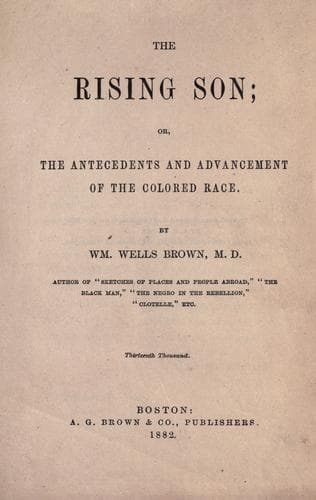
The Rising Son; or, the Antecedents and Advancement of the Colored RaceBrown, William Wells
History
The Rising Son; or, the Antecedents and Advancement of the Colored Race
Brown, William Wells
African Americans -- Biography; African Americans -- History; Black race; Slavery -- United States
Christophe felt that his assumption of power was but a usurpation, and
that so long as his government remained in operation without the formal
sanction of the people, his rival at Port au Prince possessed immense
advantages over him, inasmuch as he had been made the constituted head
of the country by an observance of the forms of the constitution. To
remedy this palpable defect, which weakened his authority, he resolved
to frame another constitution, which would confirm him in the power he
had usurped, and furnish him with a legal excuse for maintaining his
present attitude. In accordance with this policy he convoked another
assembly at Cape François, composed of the generals of his army and
the principal citizens of that province, and after a short session
these subservient legislators terminated their labors by giving to
the world another constitution of the country, dated upon the 17th of
February, 1807. This new enactment declared all persons residing upon
the territory of Hayti, free citizens, and that the government was to
be administered by a supreme magistrate, who was to take the title of
President of the State, and General-in-Chief of the land and the naval
forces.
The office was not hereditary, but the president had the right
to choose his successor from among the generals of the army; and
associated with him in the government there was to exist a Council
of State, consisting of nine members, selected by the President from
among the principal military chiefs. This, like the constitution, which
conferred power upon Dessalines, made Christophe an autocrat, though he
was nominally but the mere chief magistrate of a republic.
The rival government of Port au Prince differed from that of
Christophe, by its possessing more of the forms of a republic. With
a president who held his power for life, and who could not directly
appoint his successor, there was associated a legislative body,
consisting of a chamber of representatives chosen directly by the
people, and a senate appointed by the popular branch of the government,
to sustain or control the president in the exercise of his authority.
Hostilities between Christophe and Pétion were carried on for a long
time, which led to little less than the enfeeblement of both parties.
The black chief, however, established his power on solid foundations
in the North, while Pétion succeeded in retaining a firm position in
the South. Thus was the Island once more unhappily divided between two
authorities, each of which watched its opportunity for the overthrow of
the other.
Public-domain text, read in full here on John Shaqi.
Reviews
Reviews
No reviews yet
Be the first to share your thoughts on this work.
Elsewhere in the archive
Join the Discussion
Join the discussion
Sign in to leave a comment or review.
Sign InorCreate an account