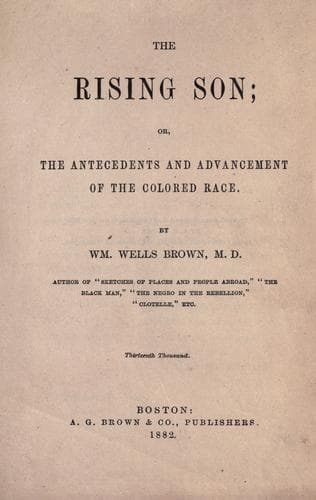
The Rising Son; or, the Antecedents and Advancement of the Colored RaceBrown, William Wells
History
The Rising Son; or, the Antecedents and Advancement of the Colored Race
Brown, William Wells
African Americans -- Biography; African Americans -- History; Black race; Slavery -- United States
The struggle between the two presidents of Hayti had now continued
three years, when a new competitor started up, by the arrival of Rigaud
from France. He had passed by way of the United States, and arrived
at Aux Cayes on the 7th of April, 1810. This was an unexpected event,
which awakened deep solicitude in the bosom of Pétion, who could not
avoid regarding that distinguished mulatto as a more formidable rival
than Christophe. He feared his superior talents, and dreaded the
ascendency he held over the mulatto population. Rigaud was welcomed
by his old adherents with enthusiastic demonstrations of attachment
and respect; and after enjoying for a few days the hospitalities that
were so emulously offered to him, he proceeded on his way to Port au
Prince. Though Pétion could not feel at his ease while such a rival
was journeying in a species of triumph through the country, he dared
not, at least in his present condition, to make an open manifestation
of his displeasure, or employ force against one who had such devoted
partisans at his command. He determined, therefore, to mask his jealous
feelings, and wear an exterior of complaisance, until he could discover
the designs of Rigaud. The latter was received graciously by the
President, whose suspicions were all effectually lulled by the harmless
deportment of the great mulatto chieftain; and he was even invested by
Pétion with the government of the South. This was to place an idol in
the very temple of its worshippers, for Rigaud returned to Aux Cayes to
draw all hearts to himself. No one in that province now cast a thought
upon Pétion; and within a short period Rigaud was in full possession
of his ancient power. Pétion, affrighted at his situation, surrounded
as he was by two such rivals as Rigaud and Christophe, began an open
rupture with the former before he had fully ascertained whether he
could sustain himself against the hostilities of the latter. Some of
the mulattoes, who, with a spirit of patriotism or clanship foresaw
the triumphs which would be offered to the blacks by civil dissensions
among themselves, proposed a compromise between Rigaud and Pétion; but
this was rejected by the latter, who began to make preparations to
invade Rigaud’s province.
Resolved to profit by this division, Christophe marched against Pétion,
but the common danger brought about a union, and Christophe judged it
prudent to retire.
Public-domain text, read in full here on John Shaqi.
Reviews
Reviews
No reviews yet
Be the first to share your thoughts on this work.
Elsewhere in the archive
Join the Discussion
Join the discussion
Sign in to leave a comment or review.
Sign InorCreate an account