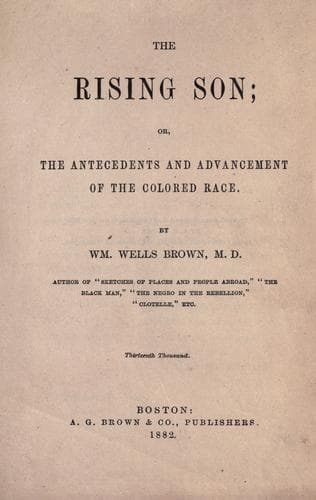
The Rising Son; or, the Antecedents and Advancement of the Colored RaceBrown, William Wells
History
The Rising Son; or, the Antecedents and Advancement of the Colored Race
Brown, William Wells
African Americans -- Biography; African Americans -- History; Black race; Slavery -- United States
They added that the majority of the nation felt with them the necessity
of establishing an hereditary monarchy in the country, inasmuch as
a government administered by a single individual was, less than any
other, subject to the chances of revolution, as it possessed within
itself a higher power to maintain the laws, to protect the rights of
citizens, to preserve internal order, and maintain respect abroad; that
the title of governor-general, which had been conferred upon Toussaint
L’Ouverture, was insufficient to the dignity of a supreme magistrate;
that that of emperor, which had been bestowed upon Dessalines, could
not in strictness be conferred but upon the sovereign of several states
united under one government, while that of president did not, in fact,
carry with it the idea of sovereign power at all. In consideration of
these grave objections to all other terms to designate the supreme head
of the state, the council expressed itself driven at last to adopt the
title of king. The council next proceeded by a formal decree to confer
the title of King of Hayti upon Henri Christophe and his successors
in the male line, and to make such changes and modifications in the
constitution of 1807 as were required by the recent alteration in the
structure of the government.
On the 4th of April, the Council of State, which, with the additions
made to their number from among the chiefs of the army and the leaders
among the population, was pompously styled the Council General, in
their robes of state, and headed by their president, proceeded to the
palace of Christophe, to announce in formal terms the termination
of their labors, which had resulted in the formation of a new
constitution, making the crown of Hayti hereditary in the family of
the reigning prince. After a speech filled with the very essence of
adulation, the President of the Council, General Romaine, exclaimed
in the presence of the sovereign, “People of Hayti, regard with pride
your present situation. Cherish no longer any fears for the future
prosperity of your country, and address your gratitude to Heaven; for
while there exists a Henry upon the throne, a Sully will ever be found
to direct the march of your happiness.”
On the day following, the new constitution was proclaimed by official
announcement throughout the kingdom, and Christophe entered upon the
exercise of the kingly powers which had been conferred upon him. The
first act of his reign was the promulgation of a royal edict, creating
an hereditary nobility, as a natural support to his government, and
an institution to give éclat and permanence to his sovereignty. These
dignitaries of the kingdom were taken mostly from among the chiefs
of the army, and consisted of two princes, not of the royal blood,
of seven dukes, twenty-two counts, thirty-five barons, and fourteen
chevaliers.
Public-domain text, read in full here on John Shaqi.
Reviews
Reviews
No reviews yet
Be the first to share your thoughts on this work.
Elsewhere in the archive
Join the Discussion
Join the discussion
Sign in to leave a comment or review.
Sign InorCreate an account