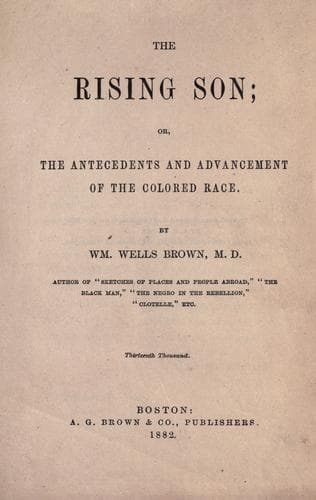
The Rising Son; or, the Antecedents and Advancement of the Colored RaceBrown, William Wells
History
The Rising Son; or, the Antecedents and Advancement of the Colored Race
Brown, William Wells
African Americans -- Biography; African Americans -- History; Black race; Slavery -- United States
Of priority in rank among the princes of the kingdom, were those of the
royal blood, consisting of the two sons of Christophe, the eldest of
whom, as heir apparent, received the title of Prince Royal.
Having finished these creations of his new monarchy, and received
the two royal crowns of Hayti, Christophe appointed the 2d of June,
1811, as the day for his coronation. All the chiefs of the army and
other grandees of the realm had orders to repair to the capital, and
among them there appeared a deputation from the blacks of the Spanish
territory, who had assumed to themselves the pompous appellations of
Don Raphael de Villars, chief commandant of Santiago; Don Raymond de
Villa, commandant of Vega; Don Vincent de Luna, and Don José Thabanes,
who at least represented the Spanish creoles by the grandiloquence
of their names. An immense pavilion had been erected upon the Place
d’Armes of Cape Henry, furnished with a throne, galleries for the
great ladies of the court, chapels, oratories, an orchestra, and all
the arrangements necessary for the august ceremony. This was performed
in due stateliness by the new archbishop of Hayti, the capuchin Brelle,
who consecrated Christophe King of Hayti, under the title of Henry the
First.
FOOTNOTE:
[39] Lacroix.
CHAPTER XVIII.
CHRISTOPHE AS KING, AND PÉTION AS PRESIDENT OF HAYTI.
Christophe, now enthroned as the sovereign of the North, seized upon
the leisure which was afforded him after perfecting the internal
details of his new government, to attempt a peaceable union of the
blacks of the South with those who were already the loyal subjects
of what he considered the legitimate authority of the Island. For
this purpose a large deputation was dispatched from his capital, to
proceed into the territory of the republic as the envoys of the black
king, who proposed the union of the whole population in one undivided
government, secured under the form of an hereditary monarchy, both
from the revolutions and weakness of one, the structure of which was
more popular. These emissaries, sent to declare the clemency and
peaceful intentions of the monarch of the North, were taken from among
the prisoners who had fallen into the power of Christophe by the
capitulation of the Mole St. Nicholas, and who had been adopted into
the royal army, and made the sharers of the royal bounty of the black
king. To assist in this new measure, a proclamation was issued from
the palace at Cape Henry on the 4th of September, 1811, addressed to
the inhabitants of the South, who were no longer called the enemies of
the royal government, but erring children, misled by the designing;
and they were implored to return to their allegiance to the paternal
government of that chief who had just been constituted the hereditary
prince of the blacks. “A new era,” said this royal document, “has now
dawned upon the destinies of Hayti.
Public-domain text, read in full here on John Shaqi.
Reviews
Reviews
No reviews yet
Be the first to share your thoughts on this work.
Elsewhere in the archive
Join the Discussion
Join the discussion
Sign in to leave a comment or review.
Sign InorCreate an account