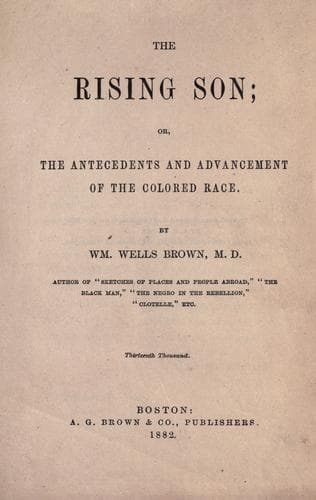
The Rising Son; or, the Antecedents and Advancement of the Colored RaceBrown, William Wells
History
The Rising Son; or, the Antecedents and Advancement of the Colored Race
Brown, William Wells
African Americans -- Biography; African Americans -- History; Black race; Slavery -- United States
So unlimited and habitual was his severity, that it was said of
him that he would put a man to death with as little hesitation as
a sportsman would bring down an article of game. His dungeons were
filled with thousands of victims of all colors, and new detachments of
prisoners were daily arriving to swell the number. The innocent were
confounded with the guilty; for under the promptings of his hatred or
jealousy, the despot would not stop to make nice discriminations.
CHAPTER XXI.
INSURRECTION, AND DEATH OF CHRISTOPHE.
Christophe, who now might be denominated the Caligula of the blacks,
was every day adding to the discontent and terror of his subjects. His
soldiers were treated with extreme severity for every real or fancied
fault, and they sought for nothing so earnestly as for an occasion
to abandon his service, and gain an asylum within the territories
of his rival; or to attempt, what they scarcely dared to meditate,
the dethronement of a tyrant who caused them to pass their lives in
wretchedness. Christophe possessed a knowledge of this disaffection
entertained towards him, and instead of seeking to assure and
perpetuate the allegiance of his army, to the bayonets of which he was
indebted for his power, his vengeance became every day more watchful
and more terrible, until his conduct exceeded in cruelty even that
which had already spread hatred and misery throughout the nation.
Christophe determined to rule through the inspirement of fear alone,
and he practised no arts of conciliation to preserve to his interests
those even who were necessary to the maintenance of his power.
His despotism was thus carried beyond the limits of endurance. So
far from seeking to attach his great officers to his own person, by
lavishing upon them the favors of his government, his suspicions had
become alarmed at the growing wealth of his nobles, in consequence
of the immense incomes drawn by them from the estates placed under
their control, within the districts of which they were the titulary
lords. To prevent this inordinate increase of wealth among a class of
persons who, it was thought, might one day employ it against the throne
and dignity of the sovereign, an institution was formed, called the
Royal Chamber of Accounts, which, by a sort of star-chamber process,
appraised the estates of the nobility, and disburdened them of so
much of their wealth as the king deemed a matter of superfluity to
them. Several of the black nobles had already been subjected to the
jurisdiction of this royal court; and, actuated by secret indignation
for this arbitrary spoliation of their property, they sought only for
an opportunity to drive Christophe from his power, in the hope to share
the same authority among themselves.
In the month of August, 1820, Christophe, while attending mass, was
attacked with paralysis, and was immediately carried to his palace at
Sans Souci, where he remained an invalid for many months, to the great
satisfaction of his subjects.
Public-domain text, read in full here on John Shaqi.
Reviews
Reviews
No reviews yet
Be the first to share your thoughts on this work.
Elsewhere in the archive
Join the Discussion
Join the discussion
Sign in to leave a comment or review.
Sign InorCreate an account