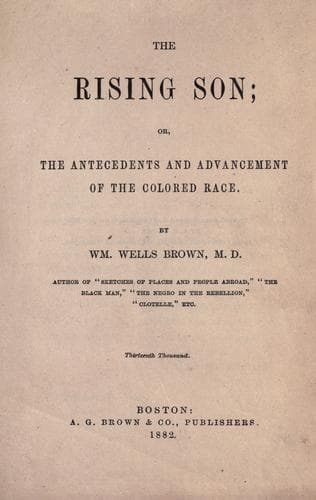
The Rising Son; or, the Antecedents and Advancement of the Colored RaceBrown, William Wells
History
The Rising Son; or, the Antecedents and Advancement of the Colored Race
Brown, William Wells
African Americans -- Biography; African Americans -- History; Black race; Slavery -- United States
This event, so favorable to the treacherous designs of the discontented
chiefs of his government, furnished an occasion for the formation of a
dangerous conspiracy, at the head of which were Paul Romaine, Prince
of Limbe, and General Richard, the governor of the royal capital.
The conspirators designed to put Christophe to death, and after the
performance of a deed so acceptable to the nation, to form a northern
republic, similar in its structure to that which existed in the South,
at the head of which was to be placed General Romaine, with the title
of president.
But before this scheme could be carried out, a division of the royal
army, stationed at St. Marks, and consisting of a force of six thousand
men, exasperated at the cruelties practiced upon them, seized upon
this occasion to revolt. The commanding general was beheaded, and a
deputation of the mutineers was dispatched to carry the head of the
murdered officer to the president of the republic at Port au Prince.
The intelligence of this revolt was carried quickly to Christophe’s
capital, and it produced an explosion of popular feeling that betokened
the speedy downfall of the black monarchy. The troops of the capital
immediately put themselves under arms, and assumed a threatening
attitude. On the evening of the 6th of October, the inhabitants of the
capital were startled at the noise of drums beating to arms.
The streets were soon filled with soldiers, obeying or resisting the
authority of their officers, as the latter happened to favor or hate
the power of the king. The governor of the capital, who did not wish
for such a dénouement to his plans, undertook measures to subdue the
mutinous spirit of the troops; but though he sought for support on
every side, he found no readiness, either on the part of the army or
of the people, to assist him in his attempt. The tumult increased
every moment, and spread by degrees to every part of the town, until
the whole population became united in the rebellion. The army took the
lead, and the whole body of the inhabitants followed the example of
the soldiers. It was decided by acclamation to march upon Sans Souci,
and seize upon Christophe within his own palace, but this movement was
deferred until the following day.
Meantime, Christophe had been informed of these proceedings, so ominous
to the preservation of his power, if not of his life. He had not yet
recovered from his malady, but his unconquerable energy of soul had
not been paralyzed by disease, for he leaped immediately from his bed,
demanding that his arms should be brought to him, and that his horse
should be ordered to the door. But if his bold spirit did not quail
before the calamities which were impending over him, his bodily frame
proved unequal to the activity of his mind, and he was compelled to
rest satisfied with sending forward his guards to subdue the rebellious
troops of the capital, while he remained within his palace to await his
destiny.
Public-domain text, read in full here on John Shaqi.
Reviews
Reviews
No reviews yet
Be the first to share your thoughts on this work.
Elsewhere in the archive
Join the Discussion
Join the discussion
Sign in to leave a comment or review.
Sign InorCreate an account