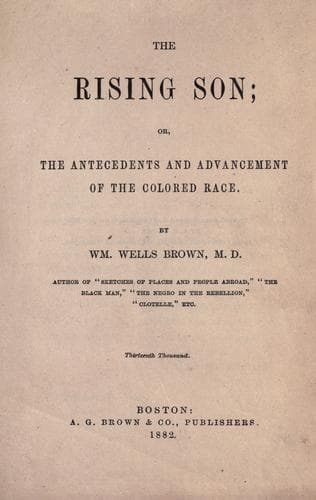
The Rising Son; or, the Antecedents and Advancement of the Colored RaceBrown, William Wells
History
The Rising Son; or, the Antecedents and Advancement of the Colored Race
Brown, William Wells
African Americans -- Biography; African Americans -- History; Black race; Slavery -- United States
Meantime, General Richard, the governor of the capital, had put himself
at the head of the insurgents, the number of whom amounted to ten or
twelve thousand, and the column took up its march directly for Sans
Souci. On Sunday, the 8th of October, the insurgents encountered
on their way the detachment of body guards which the monarch had
dispatched against them.
The two forces quickly arranged themselves in order of battle, and a
brisk fire commenced between them. It continued, however, but a few
minutes. The cry of the insurgents was, “Liberté, liberté,” and the
utterance of this magical word soon became contagious in the ranks of
the royal guards. The latter had even less predilection for their
monarch than the other corps of the army, for their situation and
rank bringing them in nearer contact with the royal person, they were
frequently exposed to the terrific explosions of the royal vengeance.
Thus the watchword of the mutineers was answered with redoubled
enthusiasm by the household troops, and they passed over in a body to
join the forces of the insurgents. The whole military power of the
kingdom was now united in a vast column of mutineers, burning for
vengeance upon Christophe, and pressing onward to the palace of Sans
Souci.
The king was soon informed that his guards had declared against him,
and that the forces of the insurgents were already in the immediate
vicinity of his palace. At this astounding intelligence he exclaimed in
despair, “Then all is over with me!” and seizing a pistol, shot himself
through the heart.
Thus perished a man who had succeeded in maintaining his authority over
the blacks for a longer time than any of the chiefs of the revolution.
This he accomplished through the single agency of the extraordinary
energy of his character. The unshrinking boldness and decision of his
measures made terror the safeguard of his throne, until his excessive
cruelty drove his subjects to a point at which fear is changed into
desperation. His policy at first was that of Toussaint, but he carried
it to an access of rigor which made his government a despotism.
Like his great predecessor, he possessed such intimate knowledge
of the African character, as enabled him to succeed completely in
controlling those placed under his sway, and, in spite of the national
propensities, to make his plans effectual for developing the resources
of the country. While the territory was still a neglected waste, and
its population poor, the lands of Christophe were in a condition of
high productiveness, and the monarch died, leaving millions in the
royal treasury.
Public-domain text, read in full here on John Shaqi.
Reviews
Reviews
No reviews yet
Be the first to share your thoughts on this work.
Elsewhere in the archive
Join the Discussion
Join the discussion
Sign in to leave a comment or review.
Sign InorCreate an account