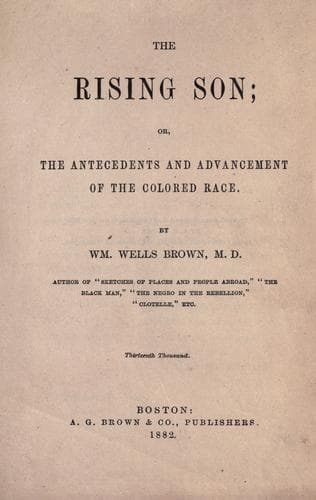
The Rising Son; or, the Antecedents and Advancement of the Colored RaceBrown, William Wells
History
The Rising Son; or, the Antecedents and Advancement of the Colored Race
Brown, William Wells
African Americans -- Biography; African Americans -- History; Black race; Slavery -- United States
At length, in 1825, after the recognition of the independence of Hayti
by others, the French, under Charles X., sold to its inhabitants the
rights which they had won by their swords for the sum of one hundred
and fifty millions of francs, to be paid as an indemnity to the
colonists. This was the basis of a treaty of peace and fraternal
feeling between France and Hayti, that resulted in great good to
the latter. In 1843, a party opposed to president Boyer made its
appearance, which formed itself into a conspiracy to overthrow the
government. Seeing that he could not make head against it, Boyer, in
disgust, took leave of the people in a dignified manner, and retired to
the island of Jamaica, where, a few years since, he died.
Jean Pierre Boyer was born at Port au Prince, on the second of
February, 1776, received a European education at Paris, fought under
Rigaud and Toussaint L’Ouverture; and in consequence of the success
which the black leader obtained, quitted the Island. Boyer returned to
Hayti in Le Clerc’s expedition; he, however, separated from the French
general-in-chief, and joined in the foremost in the great battle for
the freedom of his race. He was a brave man, a good soldier, and proved
himself a statesman of no ordinary ability. When he came into power,
the mountains were filled with Maroons, headed by their celebrated
chief, Gomar; Rigaud and Pétion had tried in vain to rid the country of
these brigands.
Boyer, however, soon broke up their strongholds, dispersed them,
and finally destroyed or brought them all under subjection. By his
good judgment, management, and humanity, he succeeded in uniting the
whole island under one government, and gained the possession of what
Christophe had exhausted himself with efforts to obtain, and what
Pétion had sighed for, without daring to cherish a single hope that
its attainment could be accomplished. Few men who took part in the St.
Domingo drama, did more good, or lived a more blameless life, than
Boyer.
CHAPTER XXIII.
SOULOUQUE AS EMPEROR OF HAYTI.
General Riche, a _griffe_, or dark mulatto, was selected to fill the
place left vacant by the flight of Boyer; and his ability, together
with the universal confidence reposed in him by all classes, seemed to
shadow forth a prosperous era for the republic. He had, however, done
little more than enter upon his arduous duties, when he was carried off
by a sudden malady, universally regretted by the entire population.
The Senate, whose duty it was to elect the president, gave a majority
of their votes for Faustin Soulouque, on the first of March, 1847, and
he was inaugurated into the position the same day.
Public-domain text, read in full here on John Shaqi.
Reviews
Reviews
No reviews yet
Be the first to share your thoughts on this work.
Elsewhere in the archive
Join the Discussion
Join the discussion
Sign in to leave a comment or review.
Sign InorCreate an account