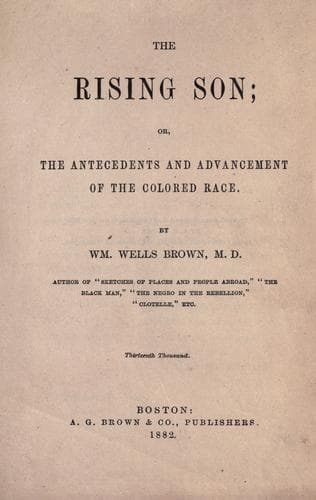
The Rising Son; or, the Antecedents and Advancement of the Colored RaceBrown, William Wells
History
The Rising Son; or, the Antecedents and Advancement of the Colored Race
Brown, William Wells
African Americans -- Biography; African Americans -- History; Black race; Slavery -- United States
Soulouque was a tall, good-natured, full-blooded negro, who, from the
year 1804, when he was house-servant for General Lamarre, had passed
through all the events of his country without leaving any trace of
himself, whether good or bad. With no education, no ability, save that
he was a great eater, he was the last man in the republic that would
have been thought of for any office, except the one he filled.
True, in 1810, while his master, General Lamarre, was defending the
Mole against Christophe, the former was killed, and Soulouque was
charged to carry the general’s heart to Pétion, who made the servant a
lieutenant in his mounted guard; and on Pétion’s death, he bequeathed
him to Boyer, as a piece of furniture belonging to the presidential
palace. Boyer made Soulouque first servant, under the title of
“captain,” to his housekeeper. Here he grew fat, and was forgotten
till 1843, when the revolution brought him into note. After serving a
short time as president, his vanity induced Soulouque to aspire to be
emperor, and that title was conferred upon him in the year 1849. In
this silly step he took for his model Napoleon Bonaparte, according to
whose court and camp Soulouque formed his own.
But the people of Hayti soon saw the sad mistake in the election of
such a man to power, and his change of base aroused a secret feeling
against the empire, which resulted in its overthrow, in 1859.
CHAPTER XXIV.
GEFFRARD AS PRESIDENT OF HAYTI.
Fabre Geffrard was born at Cayes September 19, 1806. His father was
General Nicholas Geffrard, one of the founders of Haytian independence.
He became a soldier at the early age of fifteen, and after serving in
the ranks, passed rapidly through several grades of promotion, until
he obtained a captaincy. In 1843, when General Herard took up arms
against President Boyer, he choose Geffrard for his lieutenant, who,
by his skill and bravery, contributed largely to the success of the
revolutionary army. As a reward for his valuable services, he received
from the new government the brevet rank of general of brigade, and was
commandant of Jacmel, and in 1845 he was named general of division.
In 1849 he was appointed by Soulouque to take command of his Haytian
army sent against the Dominicans, and in 1856 it fell to his lot, by
the display of rare military talents, to repair in some measure the
disasters attending the invasion of St. Domingo by the Haytian army,
led by the emperor himself. Shortly after, Soulouque, moved thereto,
doubtless, by jealousy of Geffrard’s well-earned fame, disgraced him;
but the emperor paid dearly for this, for in December, 1858, Geffrard
declared against him, and in January, 1859, Soulouque was overthrown,
with his mock empire, and Geffrard proclaimed President of the
Republic, which was restored.
Public-domain text, read in full here on John Shaqi.
Reviews
Reviews
No reviews yet
Be the first to share your thoughts on this work.
Elsewhere in the archive
Join the Discussion
Join the discussion
Sign in to leave a comment or review.
Sign InorCreate an account