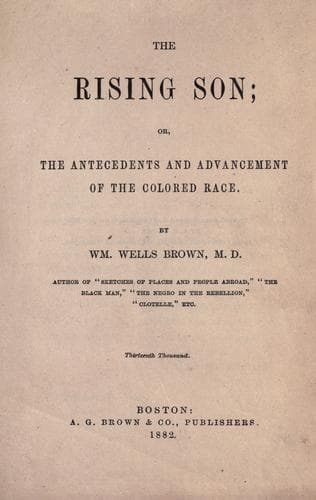
The Rising Son; or, the Antecedents and Advancement of the Colored RaceBrown, William Wells
History
The Rising Son; or, the Antecedents and Advancement of the Colored Race
Brown, William Wells
African Americans -- Biography; African Americans -- History; Black race; Slavery -- United States
In the mean time, an opposition, not to the slave-trade alone, but
to slavery, too, gradually strengthened itself within the empire.
Manumission became frequent, and the laws made it very easy. A society
was organized under the protection of the emperor, which, every year,
in open church, solemnly liberated a number of slaves; and in 1856 the
English Embassador wrote home that the government had communicated
to him their resolution gradually to abolish slavery in every part
of the empire. The grand step which they have now taken has no doubt
been impelled by the example of our own country. It is one of the many
precious fruits which have sprung, and are destined yet to spring, from
the soil which we watered so freely with patriot blood.
Information generally, with regard to Brazil, is scanty, especially in
connection with the blacks; but in all the walks of life, men of color
are found in that country.
In the Brazilian army, many of the officers are mulattoes, and some of
a very dark hue. The prejudice of color is not so prominent here, as in
some other slaveholding countries.
CHAPTER XXVIII.
CUBA AND PORTO RICO.
Cuba, the stronghold of Spain, in the western world, has labored
under the disadvantages of slavery for more than three hundred years.
The Lisbon merchants cared more for the great profits made from the
slave-trade, than for the development of the rich resources of this,
one of the most beautiful of the West India Islands, and therefore,
they invested largely in that nefarious traffic. The increase of
slaves, the demand for sugar and the products of the tropics, and the
inducement which a race for wealth creates in the mind of man, rapidly
built up the city of Havana, the capital of the Island. The colored
population of Cuba, like the whites, have made but little impression on
the world outside of their own southern home. There is, however, one
exception in favor of the blacks. In the year 1830, there appeared in
Havana a young colored man, whose mother had recently been brought from
Africa. His name was Placido, and his blood was unmixed. Being with a
comparatively kind master, he found time to learn to read, and began
developing the genius which at a later period showed itself.
The young slave took an interest in poetry, and often wrote poems which
were set to music and sung in the drawing-rooms of the most refined
assemblies in the city. His young master, paying his addresses to a
rich heiress, the slave was ordered to write a poem embodying the
master’s passion for the young lady. Placido acquitted himself to the
entire satisfaction of the lover, who copied the epistle in his own
hand, and sent it on its mission. The slave’s compositions were so much
admired that they found their way into the newspapers; but no one knew
the negro as their author.
Public-domain text, read in full here on John Shaqi.
Reviews
Reviews
No reviews yet
Be the first to share your thoughts on this work.
Elsewhere in the archive
Join the Discussion
Join the discussion
Sign in to leave a comment or review.
Sign InorCreate an account