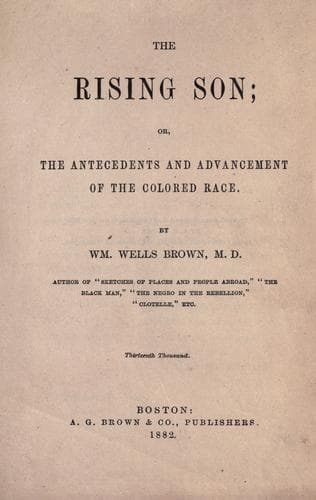
The Rising Son; or, the Antecedents and Advancement of the Colored RaceBrown, William Wells
History
The Rising Son; or, the Antecedents and Advancement of the Colored Race
Brown, William Wells
African Americans -- Biography; African Americans -- History; Black race; Slavery -- United States
The missionaries, and especially the Baptists, who had been laboring
against great disadvantages before the abolition of slavery, now that
the curse was out of the way, did a noble work for the freed people.
The erection of chapels all through the Island soon changed the moral
and social condition of the blacks, as well as gave them a right idea
of Christian duty.
FOOTNOTES:
[42] “Jamaica, Past and Present.” Phillippo.
[43] Phillippo.
[44] Phillippo.
[45] “Jamaica, Past and Present.” Phillippo.
CHAPTER XXVII.
SOUTH AMERICA.
The Portuguese introduced slavery into Brazil about the year 1558, and
the increase of that class of the population was as rapid as in any
part of the newly discovered country. The treatment of the slaves did
not differ from Jamaica, St. Domingo, and Cuba.
Brazil has given the death-blow to the wicked system which has been so
long both her grievous burden and her foul disgrace. Henceforth, every
child born in the empire is free, and in twenty years the chains will
fall from the limbs of her last surviving slave. By this decree, nearly
three million blacks are raised up from the dust; and though but few
of this generation can hope to see the day of general emancipation, it
is much for them to know that the curse which rested on the parents
will no longer be transmitted to the children; it is something that
the younger of them have a bright although distant future to look
toward and to wait for. Very likely, too, the dying institution will
not be suffered to linger out the whole of the existence which the new
law accords to it; as the benefits of free labor to the whole country
become appreciated fresh legislation may hasten the advent of national
liberty and justice.
The first colonists enslaved the Indians; and, despite the futile
measures of emancipation adopted by the Portuguese crown in 1570, in
1647, and in 1684, these unfortunate natives remained in servitude
until 1755, and would perhaps have been held to this day, had they
not proved very unprofitable. Negroes were accordingly imported from
other Portuguese dominions, and a slave-trade with the African coast
naturally sprang up, and is only just ended. Portugal bound herself
by treaty with England, in 1815, to abolish the trade. Brazil renewed
the obligation in her own name in 1826. Yet in 1839 it was estimated
that eighty thousand blacks were imported every year; and, ten years
later, the Minister of Foreign Affairs reported that the brutal traffic
had only been reduced one-fourth. The energetic action of England,
declaring in 1845 that Brazilian slave-ships should be amenable to
English authorities, led to a long diplomatic contest, and threats of
war; but it bore fruit in 1850 in a statute wherein Brazil assimilated
the trade to piracy, and in 1852 the emperor declared it virtually
extinct.
Public-domain text, read in full here on John Shaqi.
Reviews
Reviews
No reviews yet
Be the first to share your thoughts on this work.
Elsewhere in the archive
Join the Discussion
Join the discussion
Sign in to leave a comment or review.
Sign InorCreate an account