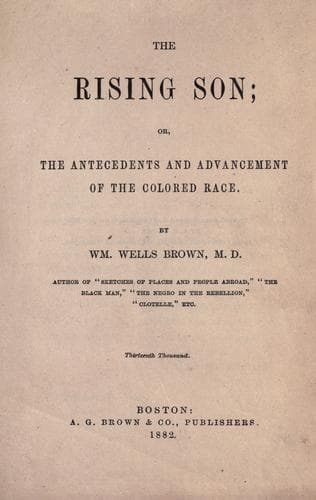
The Rising Son; or, the Antecedents and Advancement of the Colored RaceBrown, William Wells
History
The Rising Son; or, the Antecedents and Advancement of the Colored Race
Brown, William Wells
African Americans -- Biography; African Americans -- History; Black race; Slavery -- United States
In Porto Rico, Dubois, a mulatto, paid the penalty of his head for his
boldness and patriotism. There were in Cuba, in 1862, two hundred and
twenty-one thousand four hundred and seventeen free colored people, and
three hundred and sixty-eight thousand five hundred and fifty slaves.
In Porto Rico, in the same year, there were two hundred and forty-one
thousand and fifteen free colored people, and forty-one thousand seven
hundred and thirty-six slaves.
When the English troops invaded the Island of Cuba, in 1762, the
negroes behaved so well during the siege at Havana, that a large
number of them received from Governor Prado’s hands, and in the name
of the King, their letters of emancipation, in acknowledgment of their
gallantry and good services.
CHAPTER XXIX
SANTO DOMINGO.
Although not strictly a Spanish possession, Santo Domingo may be
counted in, with the people already enumerated in the West Indies.
Its history is identical with that of Hayti. Forming a part of the
same Island, and inhabited by blacks, mulattoes, and whites; and being
part of the battle-ground upon which the negroes fought the French, in
the revolution which freed the Island from its former masters. Santo
Domingo has passed through all the scenes of blood and desolation, only
in a milder form, that their neighbors of the other end of the Island
have experienced. Santo Domingo has been under Spanish, French, and
Haytian rule, and often a republic of her own, the latter of which she
now enjoys.
It was during the government of Boyer that the Spanish or Dominican
part of the Island was united with the French part. In relation to
this matter, gross misrepresentations have been made;--it has been
urged in defence of the Dominican claim to an independent government,
an independence based upon nullification, that they were beaten down,
trampled upon, and almost crushed before they would unite with a
nation of blacks.
The facts are these: at the time of Boyer’s election, the Spanish part
of the Island was independent, but its situation was most precarious;
the war between Spain and her revolted provinces in South America
was at its height, and the Columbian privateers which thronged the
Caribbean sea were continually plundering the people along the shores
of the Spanish coast; moreover, there were many persons in that
division of the Island who were inclined to favor a union with the
patriots of South America, but by far the largest number opposed this
suggestion.
Such was the state of things at the commencement of Boyer’s
administration. After maturely reflecting upon the difficulties by
which they were surrounded, the feeble government of the Spanish part
sought protection in a union with the Haytians, and Boyer was formally
solicited by them to grant his consent to the annexation of the Eastern
part. This request was complied with, and the Eastern region became a
part and parcel of that republic.
Public-domain text, read in full here on John Shaqi.
Reviews
Reviews
No reviews yet
Be the first to share your thoughts on this work.
Elsewhere in the archive
Join the Discussion
Join the discussion
Sign in to leave a comment or review.
Sign InorCreate an account