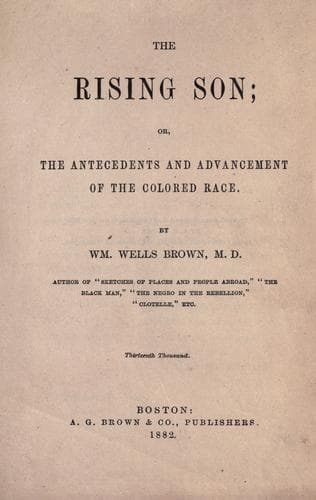
The Rising Son; or, the Antecedents and Advancement of the Colored RaceBrown, William Wells
History
The Rising Son; or, the Antecedents and Advancement of the Colored Race
Brown, William Wells
African Americans -- Biography; African Americans -- History; Black race; Slavery -- United States
Thus it is seen that the Dominicans adopted the Haytian government, not
only voluntarily, but joyfully.
At the close of Boyer’s administration the Dominicans separated from
the Haytians, and formed a republic, since which time the latter has
made war upon the former, whenever an opportunity presented itself, and
which has been the great cause of the poverty and want of development
of both sections of the Island.
Herard, who succeeded Boyer in the government of Hayti, and who was
president when the Dominicans seceded, was himself a mulatto, and there
appeared to be no cause of difficulty, but the people of Santo Domingo
wanted the change.
The Dominicans enjoyed a better state of civilization than their
neighbors, and if let alone, would soon outstrip Hayti in everything
pertaining to free and independent government.
But the Dominicans have to keep a large standing army, which takes most
of their young men, and are always in an unsettled state, which greatly
hinders the commercial and agricultural growth of the country.
Both Hayti and Santo Domingo will doubtless, at no distant day, fall
into the hands of some more civilized nation or nations, for both are
on the decline, especially as regards self-defence. Both are to-day at
the mercy of nearly all other nations, and some day the “Doctor” will
go in to look after the “Sick man.”
CHAPTER XXX.
INTRODUCTION OF BLACKS INTO THE AMERICAN COLONIES.
Simultaneously with the landing of the Pilgrims from the Mayflower,
on Plymouth Rock, December 22d, 1620, a clumsy-looking brig, old and
dirty, with paint nearly obliterated from every part, slowly sailed
up the James River, and landed at Jamestown. The short, stout, fleshy
appearance of the men in charge of the vessel, and the five empty
sour-crout barrels which lay on deck, told plainly in what country the
navigators belonged.
Even at that early day they had with them their “native beverage,”
which, though not like the lager of the present time, was a drink
over which they smoked and talked of “Farderland,” and traded for
the negroes they brought. The settlers of Jamestown, and indeed, all
Virginia at that time, were mainly cavaliers, gentlemen-adventurers,
aspiring to live by their wits and other men’s labor. Few of the
pioneers cherished any earnest liking for downright persistent muscular
exertion, yet some exertion was urgently required to clear away the
heavy forest which all but covered the soil of the infant colony, and
to grow the tobacco which easily became the staple export by means of
which nearly everything required by its people but food was to be paid
for in England.
Public-domain text, read in full here on John Shaqi.
Reviews
Reviews
No reviews yet
Be the first to share your thoughts on this work.
Elsewhere in the archive
Join the Discussion
Join the discussion
Sign in to leave a comment or review.
Sign InorCreate an account