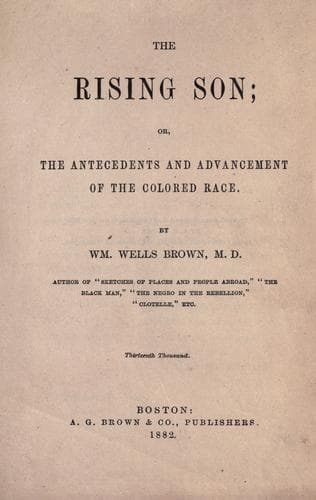
The Rising Son; or, the Antecedents and Advancement of the Colored RaceBrown, William Wells
History
The Rising Son; or, the Antecedents and Advancement of the Colored Race
Brown, William Wells
African Americans -- Biography; African Americans -- History; Black race; Slavery -- United States
“How shall we complain of arbitrary or unlimited power exerted over
us, while we exert a still more despotic and inexcusable power over a
dependent and benighted race?” was very fairly asked. Several suits
were brought in Massachusetts--where the fires of liberty burned
earliest and brightest--to test the legal right of slaveholding;
and the leading Whigs gave their money and their legal services to
support these actions, which were generally on one ground or another,
successful. Efforts for an express law of emancipation, however,
failed, even in Massachusetts; the Legislature doubtless apprehended
that such a measure, by alienating the slaveholders, would increase the
number and power of the Tories; but in 1777, a privateer having brought
a lot of captured slaves into Jamaica, and advertised them for sale,
the General Court, as the legislative assembly was called, interfered,
and had them set at liberty. The first Continental Congress which
resolved to resist the usurpations and oppressions of Great Britain by
force, had already declared that our struggle would be “for the cause
of human nature,” which the Congress of 1776, under the lead of Thomas
Jefferson, expanded into the noble affirmation of the right of “all
men to life, liberty, and the pursuit of happiness” contained in the
immortal preamble to the Declaration of Independence. A like averment
that “all men are born free and equal,” was in 1780 inserted in the
Massachusetts Bill of Rights; and the Supreme Court of that State, in
1783, on an indictment of a master for assault and battery, held this
declaration a bar to slave-holding henceforth in the State.
A similar clause in the second Constitution of New Hampshire, was
held by the courts of that State to secure freedom to every child
born therein after its adoption. Pennsylvania, in 1780, passed an act
prohibiting the further introduction of slaves, and securing freedom
to all persons born in that State thereafter. Connecticut and Rhode
Island passed similar acts in 1784. Virginia, in 1778, on motion of Mr.
Jefferson, prohibited the further importation of slaves; and in 1782,
removed all legal restrictions on emancipation. Maryland adopted both
of these in 1783. North Carolina, in 1786, declared the introduction
of slaves into the State “of evil consequences and highly impolitic,”
and imposed a duty of £5 per head thereon. New York and New Jersey
followed the example of Virginia and Maryland, including the domestic
in the same interdict with the foreign slave-trade. Neither of these
states, however, declared a general emancipation until many years
thereafter, and slavery did not wholly cease in New York until about
1830, nor in New Jersey till a much later date. The distinction of free
and slave states, with the kindred assumption of a natural antagonism
between the North and South, was utterly unknown to the men of the
Revolution.
CHAPTER XXXI.
SLAVES IN THE NORTHERN COLONIES.
Public-domain text, read in full here on John Shaqi.
Reviews
Reviews
No reviews yet
Be the first to share your thoughts on this work.
Elsewhere in the archive
Join the Discussion
Join the discussion
Sign in to leave a comment or review.
Sign InorCreate an account