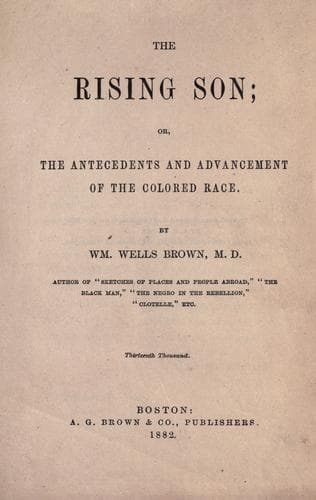
The Rising Son; or, the Antecedents and Advancement of the Colored RaceBrown, William Wells
History
The Rising Son; or, the Antecedents and Advancement of the Colored Race
Brown, William Wells
African Americans -- Biography; African Americans -- History; Black race; Slavery -- United States
The landing of the twenty slaves from the Dutch brig was the signal
for all sorts of adventurers to embark in the same nefarious traffic.
Worn-out and unseaworthy European ships, brigs, barks, schooners,
and indeed, everything else that could float, no matter how unsafe,
were brought into requisition to supply the demand for means of
transportation in the new commerce.
Thousands of persons incarcerated in the prisons of the old world
were liberated upon condition that they would man these slave-trading
vessels. The discharged convicts were used in the slave factories on
the African coast, and even the marauding expeditions sent out from
the slave ships in search of victims were mainly made up of this vile
off-cast and scum of the prison population of England, France, Germany,
Spain, and Portugal. So great was the increase of this traffic, that
in a short time the importation in a single year amounted to forty
thousand slaves.
The immense growth of the slave population in the Southern States, soon
caused politicians to take sides for or against the institution. This,
however, did not manifest itself to any very great extent, until the
struggle for National Independence was over, and the people, North and
South, began to look at their interests connected with each section of
the country.
At the time that the Declaration of Independence was put forth, no
authentic enumeration had been made; but when the first census was
taken in 1791, the total number of slaves in what are now known as the
Northern States, was forty thousand three hundred and seventy; in the
Southern, six hundred and fifty-three thousand nine hundred and ten.
It is very common at this day to speak of our revolutionary struggle as
commenced and hurried forward by a union of free and slave colonies;
but such is not the fact. However slender and dubious its legal basis,
slavery existed in each and all of the colonies that united to declare
and maintain their Independence. Slaves were proportionately more
numerous in certain portions of the South; but they were held with
impunity throughout the North, advertised like dogs or horses, and sold
at auction, or otherwise, as chattels. Vermont, then a territory in
dispute between New Hampshire and New York, and with very few civilized
inhabitants, mainly on its southern and eastern borders, is probably
the only portion of the revolutionary confederation never polluted by
the tread of a slave.
The spirit of liberty, aroused or intensified by the protracted
struggle of the colonists against usurped and abused power in the
mother-country, soon found itself engaged in natural antagonism against
the current form of domestic despotism.
Public-domain text, read in full here on John Shaqi.
Reviews
Reviews
No reviews yet
Be the first to share your thoughts on this work.
Elsewhere in the archive
Join the Discussion
Join the discussion
Sign in to leave a comment or review.
Sign InorCreate an account